Showing posts with label linux. Show all posts

Tuesday, April 28, 2009

The Continuous End-to-End Missed Opportunity of Desktop Linux

A recent PC World post asked, if Desktop Linux has missed its opportunity. Oh, boy. Did it ever.


Understand that I've been using Linux more years than I've been using Macs, and I'm sold at how solid Linux is. I rely on Linux everyday to run my back-end stuff and my network. Apple fan boy that I am, know that this isn't any religious bias when I say, Desktop Linux sucks. Let me tell you why.

The kernel aspect of it--- the schedulers, the memory management they're all good as it is. This underlying technology can handle Desktop Linux no doubt.

For years, Desktop Linux--- Gnome or KDE has had the look and feel of Windows. And it sucked. Have you seen the standard Ubuntu color?

Linux for years has offered little to differentiate itself from the market. In fact, a few years ago, no decent distro would install mp3 support natively. None. nada. You'd have to hack it to get decent mp3 playback. And the slow support by Intel, NVidia, and ATI for their graphics cards have long been an issue too (which has changed considerably in the last two years or so)! Hell, Flash Player couldn't run properly on a 64-bit Linux machine up until quite recently. Then there is the eye-candy of Compiz and Fusion are only now being integrated into the whole shebang. With technologies like XMBC Media Center, and with projects like Gnome 3.0, things are getting better right?

When Red Hat ($RHT) walked away from the consumer market, it was a punch in the stomach for Desktop Linux. No one wanted to buy it. And for good reason, you can't even play games that your friends were playing on it. And like I said, you were still expected to hack most of the media stuff yourself. Yes there were games like Tux Racer, but haven't you been a kid before? People were using windows because they liked to play PC Games too. With their friends. Wine for all its power took too long to get to market.

It wasn't so much as a developer problem writing linux native windows drivers, because TransGaming has succeeded in that. Have you seen Cider? You can run spore today on Macs and Windows using cider technology, which is based on wine. Yes, it is imperfect for hard core gamers but the casual gamer wouldn't be arguing that much, right?

So the question is, why haven't Dell ($DELL) or HP ($HPQ) jumped into integrating Linux more into their machines? Think about it: an Ubuntu base, with a customized Dell User Interface and User Experience with properly licensed mp3, dvd playback technologies that can run native windows applications like Photoshop, Office suites, Chrome, Halo, Left4Dead, and Fallout 3, why hasn't anybody done it?

Is it because they'd have to answer to Microsoft's wrath?

All this world needs is one huge PC manufacturer that has the clout to integrate Transgaming technologies, an innovative User Interface and decent User Experience and a Linux foundation and you have not just serious competition to Windows, but Desktop Linux. The real deal.

How much did Apple ($APPL) spend to initially develop OS X? Surely, Dell or a similar company can do it. Surely, other material that are not open sourced can be licensed.

If you look at Apple's success even during this recession, it is a shout in the bow that PCs and, specifically Windows--- sucks. People are tired of viruses and trojans and reboots. And while Windows 7 addresses most of the issues of Vista, have you seen how it arranges Control Panel? Seriously, the damn thing is so complicated, it takes a rocket scientist just to decipher what it all means, much less to get it to work right.

The problem of Desktop Linux has been too many cooks. Desktop Linux suffers from the Windows mentality of mediocrity. There is no focus. It looks and feels like Frankenstein on top, when in fact under the hood, the kernel and the infrastructure around it is ready. Avahi technology on linux is like Apple's bonjour for instance and it works right out of the box.

The other truth is, the best unix desktop for the consumer right now is Apple's Mac OS X and boy, it could have been Linux. Still could really. No one just has the balls to try to do it right.

Don't get me wrong, the building blocks to making a true and ultimate desktop linux experience that challenges the status quo of Microsoft's dominance is here or getting here and like Lego bricks, someone just needs to put it all together and polish it. The continuous missed opportunity is that Linux distos are following the Microsoft formula of we're software only. No one dares enough to combine in one single polished product both the PC and Linux in an end-to-end solution and tell the customer, yes, we're responsible for all of it. In the words of Alan Kay, "people who are really serious about software should make their own hardware". It's also true isn't it that people who are serious about hardware should write software as awesome as their hardware.

Wednesday, April 08, 2009

Philippine Government Sites Defaced, Linux blamed

the journal online:

"government offices hit by hackers during the period were the Department of Education, PNP, National Power Corporation, Commission on Audit, DOJ and the National Computer Center. But majority were local government units in the countryside. The last time the Congress website was defaced was in 2007.

Hackers used the Linux Operating System (OS) to deface 507 of the websites, WIN2000 71 times; and WIN2003, FREEBSD and WINNT9X 13 times each.

Of the 667 government websites defaced during the period, 507 or 76 percent were using Linux as their OS. Sosa said this is because the latter is the most common operating system being used by government offices since it is a free software and openly available."
Please spare me from people who don't know technology?
  1. So from where i stand they were able to determine that the hackers used linux to deface the sites.
  2. It isn't the operating system that was hacked but websites ergo, webservers. i'm guessing, apache was not secured/patched.
  3. The article didn't state if the machines were root hacked.
This is FUD:

“Further, these top hackers have targeted the national and local websites of the PIDS, DOST, DOLE, Napolcom, Supreme Court and Department of Education which are using the Linux Operating System, a free and openly available software which makes them highly vulnerable to hacking,” he said.

Is this because there is a pending open source bill at the house of representatives?

updated: a webserver, for you uninitiated into the world of server technology is like Microsoft Office or Yahoo Messenger. It runs on top of the Operating System (Windows). So in this case, the Webserver runs on top of Linux. The breach, so far as the article described it wasn't a breach of Linux--- but the webserver. There are myriad ways how a website may be defaced. It could also be the webserver wasn't patched or secured.

Saturday, April 04, 2009

ZDNet: 10 reasons why Linux will oust Windows

I can give two reasons why it wont (at least not in the foreseeable future):

1) User Interface and 2) User Experience

...are still way behind Windows. For example, highlight a word on any app or part of a linux desktop, whether or not it is KDE, or Gnome, and a context menu should pop that says, search in google or look up in dictionary... etc. Click it and the default browser must go to google or the machine fires up the dictionary.


On OS X this very thing makes life easy for the user:

That's just one example.

That isn't to say Linux hasn't improved over the years, and after retrying Sabayon Linux 4 the other day, I must say, it has improved a lot. It is much more useable now.

Saturday, April 12, 2008

The Philosophy of Computing Platforms (part 6)

The Way the World Is

I was asked "Why is the Mac immune to criticism on Application Integration at the Operating System Level?" this question over at twitter by @digitalfilipino in response to my posting this link by thebetaguy.com on Windows 7 development. Which led me to ask myself this question: Is the fundamental difference between platforms all about philosophy and human nature?

We took a journey down memory lane, into part of the past 30 years of our technological era. We began with a small company called Apple in 1976 that was started by two guys named Steve. We saw the rise of a pure software company, called Microsoft that was Bill Gates' and Paul Allen's and through events that favored them, became the sole provider of an Operating System for IBM's Personal Computer. And as they say, that was that.

Fast forward to 2007, Steve Jobs is one of the most admired, if not the most admired CEO in the world. Bill Gates is ending his tour of duty at Microsoft and is one of the richest in the world. We talk about the Philosophy of Computing Platform and when we look back at the last 30 years, it was shaped by these two men. 

Jobs' sense of perfection, his nature as a charmer, his salesmanship, his taking technology to an art-form, his driving belief of minimalism and simplicity and his role as the patron of the arts for our technological epoch drives Apple. His vision of a universe of integrated hardware and software whose marriage forms art is Apple's soul. 

In the same way, Gates is the vision, the pure geek energy, laser focused, calculating towards software that drives any computer in everyone's home is the source of philosophy ingrained on PC and by extension every Microsoft product the world over. 

Similarly, this Gates philosophy extends to Linux because if there is something similar to how Windows and Linux do things is that they are reflections of geek-engineering culture. Such culture, such philosophy is this technology savant imprint, a kind of rough around the edges, almost brute-force-like feel that calls for every user to be familiar with technology.

The scorn and hatred Microsoft got at the end of the 1990s haunts them to this day. It is this mistrust, this sense that Microsoft can do evil is the very fuel, the very thing that blocks them from furthering their vision of the future. It is this wall that forms criticism around everything Microsoft does. Which isn't really fair to Microsoft but is the price of being found guilty. 

At the same moment, the very nature of the PC, an Open Architecture on the hardware side is in direct conflict with a proprietary platform such as Windows. The PC world is a world where everyone can and must interact. And Windows as gatekeeper of this dynamic, Frankenstein-ish world plays a balancing act to keep legacy and future applications running. Perhaps, one day it will collapse under the weight of its own complexity or perhaps, one day it will allow itself to be transformed.

How ironic that it is quite the opposite for the Mac. The Mac is built on the same commodity parts that PCs use but engineered by Apple. Its software is based on Open technology: BSD Unix. Yet what Apple has done, it has taken this pedestrian technology and made it extraordinary (something that Linux can learn from). 

The Integration, the marriage of Hardware and Software is at the very heart, the very philosophy of Apple and in everything they do. Mac loyalists are willing to let Apple be the gatekeeper of their machines because it is no long just a mere computer, it is a consumer electronics device, sensual to the touch.

The differences between PC and Mac is the very Philosophy of their creators and their nature. PC needs to be open, needs to be a platform where anything goes (even transformed into a beauty like Mac) and accessible to everyone. In short, it fulfills the do-it-yourself mantra of hackers everywhere. Mac on the other hand is like a piece of art like that Ferrari or like a thoroughbred, gorgeous, perfection and powerful. The fundamental nature of computing platforms is the philosophy and nature and ultimately whatever the end-game of their individual creators.

The Philosophy of Computing Platforms (part 5)

Return of the Jobs

Is the fundamental difference between platforms all about philosophy and human nature?

After years of poorly executed plans, high cost of production, and failed opportunities, Apple Computer was facing death. Discounted, ridiculed and a market share as bad as OS/2 had, Apple was written off. But Apple would not go without a fight. In search for a New Operating System to jump start the company, Apple shopped around. Long story short, Apple bought NeXT--- Steve Jobs' company and in MacWorld 1997, Jobs stepped back on stage.

MacWorld 1997

When Steve Jobs returned, he brought with him Bill Gates' multimillion dollar no stock investment to Apple (think: loan) and Microsoft Office. This would prove significant. It wasn't the money. It was the deal that Microsoft would make Microsoft Office for the Mac. Jobs knew then that interoperability would be a key factor in reviving Mac shares. How could it not be? The world had standardized on Office. Everyone needed Microsoft's word processor if they were to pass documents to and from associates and business partners.

So began an Apple renaissance.

The seeds of what Mac OS X is today began after Jobs had exited Apple in 1985. The NeXT platform was Unix-based. It also had tools like Objective-C, a subset of the C language but was Object Oriented. These among others would prove to lay the foundation for the future.

The startling difference between Apple's then future OS X and Windows was its design. Clearly, OS X from the get go, was built around tools that painted a specific goal. It favored the creative mind-set of its core constituency certainly, but more than that, appeals direct to the non-hacker-non-technology-savant. The underlying layers of OS X--- Unix, Core Foundation--- Core Audio, Core Image/Core Video and now Core Animation (1997/1998) continued to serve as abstractions to the Geek dominated world of zeroes and ones.

The genius of Apple is that it uses technology and brings it to the level of art.

Take the iMac--- iconic desktop of Apple. Unlike its rivals, the iMac is an integrated platform. There are no CPU boxes, and there are three cables that go to and from the machine: a power supply, a keyboard and mouse (a fourth could be a Harman/Kardon speaker set). Heck, if you were really adventurous, you could simply run it with a wireless keyboard and mouse. The design is elegant. The machine is finely crafted. The Operating System that goes with it makes you work from the get go. Phones connect via bluetooth just like that. other devices can simply be plugged in and chances are they would just talk.

Macworld 2000

The beauty of OS X is its simplicity and well thought of design--- from simple buttons to how the computer interacts with the users in intuitive ways. Take installing software. In the windows world it would require you to answer series of questions just to install an Application. Often, this requires the user to be quite knowledgeable about technology. But with OS X, most Applications come in a disk image. It "mounts" like loading a CD on your system. And how do you install? simply just drag the App to your Applications folder (or any local folder for that matter) and you are done. Application is installed. just double click on the transferred app and you're working. No hassle. No need to think about complex stuff. Want to uninstall? just drag the App from your application folder into the trash and empty it. The power of this simplicity is that Macs don't require you to be a technology savant. It doesn't impose a barrier for the lowest most ignorant user. It makes these things abstract letting most people just use the machine. This beauty comes from a well thought of integrated foundation.

Elegance in everything is the simple nature, simple beauty of Apple.

This is the same simplicity, same elegance that Apple incorporated into the iPod and iTunes when it entered the Music business in 2001:


Apple's 1st Music Event, 2001, The First iPod

Beyond the Macs, and the iPod, what makes Apple different is its cult-like following. It is arguably the largest subculture in computing, perhaps even more so than Linux and Open Source. Leander Kahney author of (and who writes a blog of similar name), The Cult of Mac (legally free download via Bittorrent) wrote:

Mac users can be extremely cool. It's a lifestyle thing. Mac users tend to be liberal, free-thinking, counterculture. They dress well, look good, have discerning taste (in New York, anyway). Take a Mac out in public and people want to look at it. Mac users have a sense of humor. They also help eath other. Myriad Web sites help you find solutions to problems, pointers to the best deals, and great freeware or shareware.

Mac users are creative. What else would you expect from all the musicians, artists, designers, and filmmakers who make up Apple's core constituency? It's not unreasonable to say that a lot of the world's mass media--- books, magazines, movies, music, Web sites--- is made on Macs. A lot of highly creative people fire up their Macs every day to shape our culture.
This difference in culture is the predominant distinction between the design philosophy of PCs whether it is Windows-based or Linux-based.

Wednesday, April 09, 2008

The Philosophy of Computing Platforms (part 4)

The End of the Beginning

Is the fundamental difference between platforms all about philosophy and human nature?

In the Mid-1990s, a company called Netscape drew its bread and butter from selling a Web Browser and Communications (Email, HTML editor and Browser) suite at a price. When Internet Explorer became freely available on Windows and came with every copy of Microsoft's world dominant operating system, and with technologies like "Channels"--- push (similar idea to what RSS is to us now) data from the Internet to your Windows desktops became a feature of Windows 98, Netscape was losing the war.

So in the process of adding value and growing their business, Microsoft not only stepped on the toes of others already in the game developing emerging web and multimedia technologies but was figuratively shoving it down their throats.

Naturally, those emerging companies cried foul.

And this arrogance, this hubris would taint Microsoft to this day. Gone was Chancellor Palpatine who everyone respected for his ability to be politically adept. When Microsoft won the war, it had become Emperor. Well-earned nomenclature or not, the world saw them the Dark Side.

Microsoft crushed Netscape when they made Internet Explorer free and part of Windows. With every PC that came out a manufacturer's door, Microsoft's Internet Explorer was right there. Ordinary people who needed to use the nascent Web naturally would use IE. It was the first thing they saw. For Netscape, a company that sold browsers, who made a living by selling a web browser and suite, how do you fight against the very attractive price of US$0.00 and which came along with your computer, no downloads, no additional install needed?

The seeds of AntiTrust, anti-monopoly, anti-Microsoft revolution begun.

Companies started to fear Microsoft's control and it became evident. They wanted the same freedom to build applications on the Windows platform as the PC but when Microsoft started making the same applications, naturally the upstarts would die.

Everyone had to dance to Microsoft tune. And when people start to feel less free, the seeds of dissent were sowed. Revolutionaries were poised to come out of the shadows and fight a guerilla campaign openly.

Eric S. Raymond wrote a paper called "The Cathedral and the Bazaar" and published it online. This paper was more about software development. It was about the fundamental difference between writing software where everyone could see it and writing software behind closed ivory towers (Microsoft's way). In many ways, this paper helped legitimize and bring to mainstream an Open Architecture philosophy to software development in the same way that the IBM PC had opened up the commodity hardware business. The Cathedral and the Bazaar would be the geek version of a Declaration of Independence.

But dissent wasn't just with the geeks.

In the boardroom and the backdoors of silicon valley power--- companies who relied on the Openness of the PC were also revolting. Microsoft held a firm iron grip on them. Microsoft was slowing down innovation by the very nature of the "closeness". But no hardware manufacturer in their right mind would have dumped Microsoft. They'd have no business. It was a symbiotic relationship. The world had standardized on Windows as much as it had standardized on the PC. To dismantle more than 15 years of Microsoft rule would be like throwing stones at a rushing Jumbo Jet.

Much had change by 1998. The wheel was once more poised to turn. The Internet revolution had brought the network to early adapters and it was fast becoming mainstream. In accelerated the development and adaption of Linux, the world over. In Mountain View, Google was born. And Netscape, after reading Raymond's paper had announced it was opening up its browser and giving it away for free. The Open Source revolution went mainstream.

In Red Hat co-founder Robert Young's "Under the Radar" book about the rise of Red Hat, he wrote this about Intel:


Executives at the highest levels at the company had long recognized that proprietary operating system manufacturers were not moving their operating systems forward as quickly as Intel was advancing microprocessor technology. That is, Intel was being held hostage by those that controled the operating system. If it had new technology available at the processor level that would allow computer users to do new things, it had to wait until the Operating System supplier decided it was willing to build support for these features into the system.
With an open source operating system, Intel could enhance the operating system itself if to s desired, to support its new chip technology. It then could contribute the enhanced software back to everyone who was using Linux, for example. This represented the first time that operating system development might e able to keep up with the new hardware that Intel was brining to market.
Moreover, the though that it could itself begin to tune an operating system to take immediate advantage of any new chip technology it pleased was a very attractive one to Intel, which had been in lockstep with Microsoft for more than a decade.
In the latter half of the 19990s, arbitration began and Microsoft would be subject to Anti-trust hearings the world over.

Civil War was on. Companies disgruntled with the Microsoft Empire had revolted.

Young wrote further:
...the evidence showed that Microsoft was in a position to call all the shots, often bullying its supposed business partners to limit themselves to Microsoft-owned technology. Microsoft appeared to have gone so far as to dictate how fast other companies could bring out new products--- or if they could bring them out at all, for that matter.
Young continued:
...Intel vice president Steven McGeady would testify that Microsoft threatened to withhold critical technical support from intel if the chipmaker did not stop developing software that Microsoft believed competed with its own product strategies.

But Intel's eagerness to participate in the open source business had nothing to do with any animosity the chip giant had toward its partner Microsoft. Instead, Intel was about to embark on a strategic partnership that had everything to do with smart business.
If during the late 1990s, Linux's rebel hackers and companies like Intel were fighting to unshackle themselves from a Microsoft Empire, another unlikely Revolution was creeping from a different front. An old friend of Microsoft from the 1980s had returned to the company he founded. And boy, was he back with a vengeance.

Tuesday, April 08, 2008

The Philosophy of Computing Platforms (part 3)

One Windows to Rule Them All

Is the fundamental difference between platforms all about philosophy and human nature?

Bill Gates' dream that his software would run on every Computer in the world had come true. Windows in every PC made Gates and Paul Allen, two of the richest men in the world. The mid-1990s saw Windows reach the pinnacle of its success, a resounding commercial success. Perhaps, it is something about seeing someone successful that we want to pull them backdown to Earth. Perhaps, it is just the nature of all things that eventually something better comes along. However it was, after 1995, Microsoft would be perceived differently.

Unmistakably, Microsoft had taken the crown from IBM. If before the PC era, anybody who needed to buy right, all bought IBM. In the 1990s, you could never be wrong if you bought a Microsoft product. It of course was also helped that at the time, IBM was in the midst of a transformation themselves. And Apple Computer was in similar position as IBM, if not worst.

The world had changed in the 15 or so years since IBM launched the PC. It could be argued that the PC was the fundamental engine driving that change but something was already replacing the PC as the center of rapid growth. It was the maturing Network. The hardware was fast becoming ubiquitous. No longer were humans locked away as discrete islands. Humans and by extension Computers and the Data we keep, and manipulate in them, they needed to interact.

The Web was on the rise. Bill Gates had dismissed the web as the next big thing. But by 1995, even as Windows 95 was one of the most successful releases of the Operating System, clearly the Network was going to become huge. But this wasn't the vision of the future that Microsoft held. It was a time when Bill Gates didn't see the Internet as the next big thing. So Microsoft stayed away from the action, while others were building software to meet this emerging world order.

By the nature of its design and ecosystem, Windows was not a natural playmate of the network. I argue this reflects the geek attitude of Microsoft. The Windows heritage grew from islands of computers. But Windows and the PC that it ran on was the dominant platform ever. Every country, every person in the world relied on data being processed on desktop computers running Windows.

In the dark corners of the Internet, rebel hackers were sowing the seeds of dissent. Linux was born in 1991, and by 1994, the scientific community (particularly NASA Jet Propulsion Laboratory) gave birth to the Beowulf Project which in simplest terms was "Commodity Clustering". It was the idea of networking ordinary PCs to do the job of once expensive and proprietary Supercomputers. And it ran, a then largely unknown Operating System called Linux.

And while Windows was being cheered, adored and welcomed, Linux was being adapted across technical circles. It was the new Unix.

1995 was a landmark year. Red Hat Linux was born with the goal of packaging and selling the free operating system Linux. In the same year, Caldera was likewise founded. And the Apache Group build its version of its popular Webserver, Apache based on the National Center for Supercomputing Applications' HTTPd 1.3 series. And who could forget the birth of Yahoo! that same year?

A company called Netscape was an upstart that was poised to become the new Microsoft and by the time of the late 1990s--- Microsoft saw that it had to take on Netscape or else lose dominance. Microsoft of course got its Windows to play nice. Microsoft started to build web technologies and multimedia technologies with Windows. It was obvious. Maybe it was because of hubris--- Microsoft was the biggest baddest fish in the sea. They needed to expand Windows, add value for the customer base.

It was getting pretty clear by then that Microsoft was embracing the new world networked paradigm. Problem was, companies the world over were already taking advantage of it before Microsoft did. Companies like Netscape sold web browsers for example. It was their bread and butter. Nobody could ever doubt that at Redmond, the Killer Instinct was alive and well, so what happened next was also quite natural.

Netscape and Microsoft fought the First Browser War. IE versus Netscape, winner takes the Internet.

Monday, April 07, 2008

The Philosophy of Computing Platforms (part 2)

World Dominance, Winner Take All

Is the fundamental difference between platforms all about philosophy and human nature?

It was the early 1990s. The world was changing. No one knew how much it would change in such a few short years. Beyond the political--- the First Gulf War (1990-1991), the fall of the Soviet Union (1991) and the Comeback Kid Bill Clinton (1993) taking office, the nascent Internet was rising, a new operating system was humbly being born, all the while a global war for desktop computer dominance was reaching its pinnacle and would make Bill Gates and Paul Allen the richest men in the world.

Unknown to most people, the following year would be a landmark. Even while Windows was poised to become the One Operating System to Rule Them All, in 1991, a geek called Linus Torvalds from Helsinki with the aid of an Internet trying to grow, let loose Linux Kernel 0.1 and begun an underground revolution that would change the shape of the world. The emerging platform of the Internet also saw the birth of Mosaic, a web browser that would father Netscape (which would father Mozilla) and eventually bring to mainstream, a whole new network paradigm.

Let us rewind a bit to 1990. Windows 3.0 came into the fray and coupled with cheap hardware that PCs were notoriously known for, was on the road to global dominance. It was eroding Apple's market share. More people were buying PCs. It was commodity hardware that allowed everyone to have a PC. Who cared if it looked like Frankenstein? The market needed gear that worked and worked cheaply.

On Apple's corner, the momentum of Macintosh five years early was ebbing. High cost of the machine, lack of interoperability with the rest of the world proved to be a bane. Windows was slowly alienating their competitor in the broader war. Brute force won over elegance. Who needed Beauty when Frankenstein could do the same things Beauty did?

In December 1992, development for NCSA Mosaic begun and in a few months found its way to Macs and Windows PCs. That browser called Mosaic would eventually become Netscape Navigator.

And where was IBM?

If the late 80s and early 90s was a golden age for Apple and the beginnings of a World Ruled by One Windows, by 1993, it was a dark time for IBM. Big Blue was entrenched with difficulties at home. In fact, IBM was dying and dying quickly. The gigantic Elephant that was IBM was hemorrhaging money. IBM Boss at the time, Louis V. Gerstner, Jr., recounted in his book, "Who Says Elephants Can't Dance," April 1993:

At the end of May, I saw April's results, and they were sobering. Profit had declined another $400 Million, for a total decline of US$800 million for the first four months. Mainframe sales had dropped 43 percent during the same four months. Other large IBM businesses--- software, maintenance, and financing--- were all dependent, for the most part, on mainframe sales and thus, were declining as well. The only part of the company that was growing was services, but it was a relatively small segment and not very profitable. Head count had declined slightly, from 302,000 at the beginning of the year to 298,000 at the end of April. Several business unites, including application-specific software and our semiconductor businesses, were struggling.

It was clear that in 1993 the First Desktop and Operating System War was over. The Windows Flag flew proudly. IBM was dying and even Gerstner acknowledged IBM's defeat, with 5% to 6% OS/2 market share, IBM exited the PC Operating System business. And Apple? By the time Windows 95 rolled out, Apple was lost, searching for a way to recapture the glory days of Macintosh.

Windows wasn't the technically superior of either OS/2 or Mac OS (well at least in those early days of the 1990s). Windows had copied Mac OS' Graphical User Interface and gave PC users a semblance of the easy of use of the Mac. Windows PCs continued on the legacy of the 1980s. Windows ran a very open, PC architecture.

If you think about it, the quick and dirty Frankenstein approach was the very philosophy of the PC. It was what made it successful. Like the pioneers of early flight, who cared how it looked, just as long as it flew. Who cared if it had seat belts or cup holders or soft leather seats? For the longest time, it was the same with the PC.

And of course they needed an Operating System to run it and Microsoft was the only one who sold it. By the time Windows 95 came out, it was pretty much a certainty that everyone who had heard of computers, all pointed to Microsoft Windows' Start button to begin their day.

In the same way that the PC was a geek project, Windows in many ways reflected the worst of being geek. Its interface reflected the enthusiasts' idea of interface. Never mind, if everybody else had to learn it. It was for a lack of a better term, crude. But it worked. And people put up with it.

So the world had standardized on PCs. The world standardized on the philosophy of Frankenstein, after all it got the job done. People would put up with the endless reboots and crashes. If you were writing a paper and the machine crashed and you forgot to save, tough man. People would put up with blue screens of death, of viruses, of worms and trojans that had become such a part of life in a Windows PC world. It was a device everybody could buy and build and build to meet their own need so people bought into the Frankenstein Philosophy.

Could Microsoft had fixed it? perhaps. perhaps not. Why fix a well oiled machine when nobody was going to beat you? It was perhaps the price of a monopoly that continued to hunt Microsoft. Perhaps, it may not even be that but the inherent Frankensteinsim of the PC itself with its myriad combinations and legacy devices and applications that Windows had got to support. Windows needed to keep the past going. Perhaps, we can lay blame on the hubris of the victor and for sitting on their laurels for lack of technical vision for what the future held and we can even blame the nascent technology.

If you've lived in those days, it would have been evident that the dust had settled. Game over. Little would everyone know that the next chapter wasn't about to begin, it had already begun in 1989 with the birth of the Web.

The wheel was once more poised to turn.

Sunday, April 06, 2008

The Philosophy of Computing Platforms (Part 1)

The Beauty and The Beast: the Age of Commodity Computing

"Why is the Mac immune to criticism on Application Integration at the Operating System Level?" I was asked this question over at twitter by @digitalfilipino in response to my posting this link by thebetaguy.com on Windows 7 development. What follows is my train of thought on the matter.

Is the fundamental difference between platforms all about philosophy and human nature?

The story began, a long time ago, in a time, far, far away. There were two Steves, a Paul and a Bill. The age of the minicomputer was on. Steve Jobs and Steve Wozniak started a small business upstart called Apple that sold computers. Bill Gates and Paul Allen on the other hand began a software company called Microsoft, founded to sell BASIC interpreters.

Even back then, the startling differences in their corporate philosophies was evident and those differences would shape not just their companies, the information technology industry but society at large. Apple was always an integrated company, shaped by the vision and natural salesmanship and personality of Steve Jobs and driven by the engineering genius of Woz. Apple since its inception has been a synergy of those great things. And Microsoft? Its relentless software focus, and core geek philosophy of its founders would take shape in the very operating system which they would use to dominate the world.

PCs for everyone was the dream but it wasn't until the early 1980s that computers started to become commodities and enter the mainstream. Enter the IBM PC.

Before the InterWeb, PCs were islands onto themselves. No one bothered with wires, Lans and Wifis. Want data passed between computers? Someone hands you a disk. You used those archaic devices called "Floppy disks". Call 'em the precursors of the CD, the usb flash drive. The PC as was the Apple before it, was birthed by the Philosophy of the age: do it yourself computers. The difference was, the PC was an Open Architecture meaning anybody could simply design hardware that could work with the PC.

By creating an Open Architecture, IBM had created what we call today, a "community". People would come in, design a hardware that would work for the PC because the standard was freely available to everyone and no matter who manufactured the PC, that device was guaranteed to work. The appeal was that anybody could build a PC from scratch to do what they want it to do.

A computer without software is like a human without a soul, without a consciousness thus, merely a pile of wires, silicon and plastic.

Operating Systems are the consciousness and unconsciousness in humans. Part of it directs everything we humans want the computer to do. Operating Systems know where to write a piece of data into the drive. It tells the DVD-ROM the instructions to spin when we humans want to watch a movie. It knows that the keyboard is a keyboard and not a mouse. It translates our keyboard and mouse interaction into what the computer could do.

So IBM at the dawn of the PC era, needed an Operating System to run the computer. In a bit of luck or faith for one Redmond company, the Operating System was subcontracted by IBM to Microsoft. This Operating System wasn't an Open Architecture as the PC was. Nobody cared back in the day about that. People were perfectly happy that Microsoft kept the OS growing. It didn't even talk to other computers as our computers do today. The network was farther off into the future.

The explosion of the PC hardware because it was an Open Architecture sent entrepreneurs building their own version of the PC. Businesses sprung like mushrooms building devices for the PC. There were video cards, and sound cards and hard drives were soon mainstream. It was like a sprawling bazaar where people could mix and match hardware. This Openness helped create business. By seeding the world with PC hardware, IBM had made possible the commodification of computers. But all of this hardware had to talk to the computer. Microsoft's Operating System needed to know all of those diverse devices. Want your sound card to play on every PC in the world? You had to write a device driver for Microsoft's Operating System.

And where was the nascent Internet of the time? It was silently cooking the back rooms of Universities, through copper wires and phone lines, through Electronic Bulletin Boards, ARPANET and USENET what would eventually become the web remained in the providence of hackers and university researchers.

In 1984, Apple launched the Macintosh. It was a tiny box that was revolutionary. And Apple's iconic 1984 advertising for that event also started the trend of Superbowl ads. It was a well made computer. It was a computer in a box--- it wasn't just a commodity, it was an appliance like a Television is. Needless to say this vision of the future foreshadows where the IT industry is now head towards. Like many things Apple, it was ahead of its time. One might argue that sometimes, Apple is too ahead and quite often, such out of the box thinking is not appreciated by the market, at least not initially.

It wasn't to say nobody did. The amazing Apple platform, dazzled many. It opened up the Graphical User interface and introduced the mouse and we've all pointed and clicked away towards interacting with the Computer. Apple pioneered the Laser printer and ushered in the Desktop Publishing business. It revolutionized fonts and how we display information on the computer. And Five Years later, the innovation, if not the platform the Macintosh began would be the standard the world over.

And in all this Apple was true to its calling of building a package that ran well, that looked good, that was revolutionary, that worked.

But by 1985, a civil war had broken out at Apple. And Steve Jobs found himself kicked out of the very company he founded. Exiled, Steve Jobs may have found himself, young, bright and talented, he would find himself very much a serial entrepreneur founding two companies during his post Apple days. One company was called NeXT and the other Pixar. The first company ran on Unix with futuristic designs and Pixar would later create the world's first animated feature presentation. His story is far from over.

With Jobs gone from the picture, Apple still continued to rise, fueled by the revolution that was Macintosh. "A golden age," wiki quotes MacAddict was the time between 1989 and 1991.

The Operating System War of the late 1980s and early 1990s was much about platform as it was about philosophy. The Mac had pioneered the Graphical User Interface, but Windows brought the same technology to the PC side. A competition arose between the two philosophies. One based on open hardware and combined with Windows created a machine that could only be characterized as a Beast: Frankenstein. The other, elegant, graceful and was simply Beauty.

The momentum the PC was on since the early 80s fueled the tide into Microsoft's and the PCs' favor. Commodity hardware was what the market needed and wanted. Sure, grace and elegance mattered but it was a young industry. It needed to be cheap enough, rough around the edges didn't matter. What mattered was to be adapted the world over and grace and elegance did not come cheap. Quite naturally, Market forces dictated that people love Frankenstein.

The First Desktop and Operating System wasn't just between Windows and Mac OS. IBM was losing control of the business that they had founded. After making a device that was Open, virtually every company in the world would be making their own PC. Companies other than IBM were growing and winning over the PC and IBM was just lost on the hardware business. When IBM looked at the software side, they came to realize what what they had done with Microsoft, so started the war between Windows and OS/2.

Do you remember Jobs' NeXt Computer? Well, in March 1989 saw the birth of the World Wide Web by Timothy Berners-Lee, Robert Cailliau and the staff at CERN and a NeXTcube was used by Berners-Lee as the world's first Web server and was also used to write the first web browser.

And so the 1980s ended with Microsoft fighting a War against IBM on the Operating System at the PC front while battling it out with Apple on the broader market. The prize was the only prize worth fighting for: World Dominance, winner take all.

Friday, March 14, 2008

PAGASA's Got Linux Supercomputer!


Can i just shoutout, "Woot!!!" PC World Australia has a post on PAGASA (Philippine Weather Bureau) running a Debian Linux Cluster (PHP2 Million).

Apparently their old supercomputer, an SGI (PHP25 Million) was out computed by their new, more powerful and way cheaper built and operated gear. Cost per month to run their Debian Linux cluster was put at PHP10,000 as opposed to PHP200,000 month for their old SGI gear.

This is awesome news!

Monday, October 15, 2007

Tux and OS X

Some say the world should be Tux,
Some said of Big Cat OS X;
"what the heck", I said, "both're of Unix stock,"
Thus, I first favored Tux;
Years pass, Tux desktop disappoint,
Though without doubt, great on a server can,
Now that I know enough of OS X to pen:
'tis got great (Core) Foundation plan,
Big Cat is the desktop on my 802.11 LAN!

*images are from here: Linux (left character) and Leopard (right character)

Thursday, October 11, 2007

Tuesday, May 08, 2007

Linux Desktop Done Right

Is having too many choices, limiting? Cruizer, awhile back, sent me an email on this article: what apple gets right and why linux keeps slipping behind. theosib makes some interesting points in that post: 1) applications on linux are scattered all over the place, like in unix. 2) configuration files are hell to maintain (believe me, if you're not careful maintaining this on a gentoo system--- you might very well trash a completely running system), 3) applications don't inter-operate: i.e. copying from the clipboard can be hell, and lastly theosib said, ego.

First of all--- as a recent switcher (from linux to mac, a year ago), i was simply amazed at how apps are installed. It's like this, for you non-OSX users: you download the "installer". You know how you put in a flash drive in and it suddenly appears on your computer? the disk image is like having a flash drive, but not physically having it--- it exists as a file on your computer and "mounting" is the thing that happens when you plug it in. you just double-click the dmg and it mounts itself. then you find the installer. For most apps on the Mac--- you simply drag files off your dmg to a folder called "Applications". (see this cut out from my finder window, above-left)

So what happens next? What do you do next?

Well go to your Applications fold and double click the file and enjoy your new app. that's it.

where did the install wizard go? for most apps that you'll be installing? nada. the dmg has all the files it needs to run. Apps don't expect you to be downloading this or that lib or .dll file. it doesn't expect you to be a geek that you have to know where program files is or that. it just works, out of the box. just like that. it doesn't let most people think.

certainly, there is no stopping most people to find out that where /Applications is--- physically or that in a Mac OS X drive will have /usr, /var/log in there. For you Unix/Linux geeks--- be calm, breathe in, breathe out: they're all in the same places, we know and love.

i've come to appreciate this simplicity. to be sure, it hasn't stopped me from getting fink or darwinports to fetch my latest unix app. to be quite honest, i found just downloading the source file for wget for example and compiling it by hand--- is simpler. sure i miss looking at the single place for all unix apps--- like what portage does, or for you Ubuntu/Debian folks: apt-get repositories. i don't think it really is all that needed on a mac.

I did find that having an app that installs php+mysql+apache by just downloading dmg files is great for development purposes or having the same "magic" happening similarly for ruby on rails through locomotive. yes, there is no substitute for compiling these apps by hand and configuring it specifically for you, and you should do that if ever you're in the business of going production or running a data center--- but in most cases like development work, like testing, this way is the easiest way to get started working right now. no thought as to how this or that works, no thought at how the systems administrators do it. just getting down to work, right now: hassle free (or as close to it as conveniently possible).

In windows, there are similar ways on how this happens. don't ask me how because i've never done more than installing postgresql and an apache on an xp machine and it was an academic exercise more than anything really. my experience--- i don't know if it has changed in the year and half since i last done that, nothing beats the OS X experience in installing an application.

theosib talked about how configuration files are hell to maintain. he is correct. i once had a gentoo system that wouldn't boot properly because i messed up the network configuration script. i had to restart the lan--- to my surprise it wouldn't because i remember migrating from an old net configuration to a new "pristine"/default.

In Linux, all these configuration files can all be found in one place. usually, it is in /etc. now, redhat will have its way to manage itself. as does ubuntu, as does gentoo and there are as many variations as there are distros. it always peeved me that being a gentoo user, the /etc for the other distros is all over the place. Take for example, Redhat (at least when i used to use it WAY back when): /etc/xinet.d will have most of boot scripts. I forget where Ubuntu keeps its stuff but in gentoo, it's either in /etc/conf.d (for most of the boot stuff like net device configuration, clock, ntp-client, etc.) and /etc for your .conf needs.

For most people--- who the hell cares where /etc is? Take the clock: keeping time is the clock right? and when you adjust the clock in gnome or in kde--- it should properly reflect in the configuration file (whether or not it is in /etc/conf.d or in /etc or /var or /whatnut), so that when the next time you log on to the machine, the changes will be made right? It isn't really the case is it?

I always set the linux clock using vi on /etc/conf.d and installing ntp to keep it in sync. people shouldn't have to do that on their desktop right?

Networking: i blogged about this a while back in "Why I Made the Switch" and "Will You Enlist". It is what makes our world go around now. Just about every computer on Earth is connected to the Internet. Why is it in this day and age, Linux Network Management on the client/desktop side is SO archaic, it makes Windows' Networking look like a brand new luxury car? Zeroconf, NetworkManager--- so many different things, doing exactly one thing: managing the network.

Then, there is the whole debacle on Gnome and KDE. Honestly, I'm a Gnome person: i find it more intuitive than kde and i also find kde to be so much like windows not just in the look and feel but how it does things. Other than the time I ran a machine using Sabayon (a few weeks ago), i've never used KDE for years. Here you have essentially two user interfaces essentially competing against each other. are they any different? in how they do things, yes but their end goals are the same. they both benefit from beryl. they both benefit from xorg. they both exist on that space between X and the user. so why can't we have just one?

people will chose between gnome and kde, based on individual preference and based on where they get trained into using first. with respect to both the gnome and kde developers--- you guys do a hell of a job, but seriously, isn't it about time to form one single unified linux desktop?

That is the heart of the matter isn't it? Has having too many choices-- having so many parallel development created a whole mediocre ecosystem?

Don't get me wrong: Linux is robust. Its performance as a kernel is well known. It is a great kernel and the distros--- all of them do a great job of delivering great software. Technically speaking, Linux is superior technology. But I must ask: hasn't the proliferation of so many distributions--- essentially the same thing, with slight variations, almost quirk like hampered a combined effort to build the true Linux Desktop Interface?

Anyone can build a linux distribution. Every gentoo box is compiled from source and theoretically you can configure it to follow your own quirk, and from that stand point is unique. As a linux user, i don't care if i have to run VLC off a command line for instance. Or MPlayer. i don't care if by popping a DVD into the drive, i have to manually type into the command line the mount command and issue the mplayer command to play the DVD.

on the other hand, the keyboard is often the quickest way between two points and why do you think apps like Quicksilver on the Mac is such a great productivity tool?

Put this way, as geeks: we don't care if the car has a cupholder, we just need the car to go really fast. My point is that Linux is a geek thing and often things like User Interfaces get lost in the translation: "normal" people don't necessarily can follow what comes easy for most geeks. Linux, inherits this from Windows because Windows' greatest failing is that it tries to apply a geek thing to what normal people do.

OS X's human-centric user interface brings a little humanity to computing.

People rave about how great Feisty Fawn is, that Linux is finally getting to be user friendly. If by user friendly you mean you can install apps as easy as you do in windows, may I submit that is still not the best way to do it? Still, it has done a remarkable job.

By being Linux users, we've changed the world. We've challenged the technological domination of mediocre technology like Windows, with all it's holes and quirks and problems and is slowly turning the tide. Windows for all its fault is in this rat hole (not just because it wasn't ready for a networked world) because it was a victim of it's own successful ecosystem.

May i submit that we may be exchanging one dog for a similar one? For all the technological greatness of linux under the hood, it still is that roadster you built. it isn't in that level of user-ready sophistication. it is still, so very geek and not elegant. i will trust an e-commerce site to run great on linux. i will trust a production database to run great on linux or the network (dhcp, firewall) to linux or as an OS for a supercomputer.

In many ways what has made Linux so successful--- it's technological prowess is stifling it. Where is our creativity?

Then again, is it still true that hackers rule the kernel? Take this blog on Who wrote Linux 2.6.20? How large is the community? Are they not mostly being paid now by corporations to help in this? hackers need to be paid for their efforts of course, my point really is why can't the same organizations and the communities band together and focus on building a humanized, next generation user interface?

The whole cathedral and bazaar thing--- we've proven that indeed, it works. Linux being the poster child of Open Source is the best example that it works. Heck, this whole open source thing is being replicated across the world in things like the Open Architecture Network, and they want to improve the living standards of millions of people.

Linux is on every little space on the planet. It is being supported by Companies around the world, who are making a profit off the open source model. why shouldn't they? it's a good idea. Linux can be found on phones, on huge computers. it is on the top 500 computers on the planet. What linux has failed to capture is desktop space. it has eluded it. Yet why?

Apple has a Unix-based operating system as well and it is found in at least 20 million computers across the planet and it is based on open source. small number, sure, but linux can easily dwarf that, right? Windows is so bug-filled that you expect the computer to restart, several times in a day (because it is starting to be that it isn't the case anymore). And the viruses, worms and trojans--- huge problem that an entire industry has grown up both to prevent and another to use as vehicles for their nefarious schemes.

There isn't really a lack of applications on Linux, not anymore. With wine, you can run Photoshop on Linux or go Gimp. PDF readers are all free on linux. it comes with both Gnome and KDE. OpenOffice is relatively good enough for most new documents--- it's your old word docs that really is the problem and of course interoperability with just about everyone else.

Linux is "free", compared to Microsoft's Windows or Apple's Mac OSX. For one thing, you don't need to pirate something that retails for US$0.00. You don't need specialized hardware to be running Linux like Mac hardware (yes, they're still somewhat specialized in light of the Intel-switch). But people will pirate Windows and pay a few dollars for a pirate copy of it because it works with their PC and its devices.

So what gives?

people tend to forget that Linux is just a kernel. it's a brain that can coordinate the eyes, the ears, the hands, the skin. it is a great piece of software that can be ported to just about every space there is. Embedded, done. Supercomputing, done. Video Recorder (PVR/DVR), done. Desktop, you bet. technically speaking, it is possible that everything and anything can be built on top of the linux kernel. this configurability, this ability to customize is the most power feature of Linux.

don't believe me?

just look at wine. it is a Linux implementation of the Windows api. long story short it translates your windows' applications instructions to the computer into linux speak so that it can run under any linux distribution.

what is to stop Microsoft from doing what Apple has done with rosetta? Microsoft in a heartbeat can build their next generation operating system around the linux kernel or a bsd one. it may take a few years to do it, and several billion dollars but it can. What better weapon is there than to use your enemy's knowledge (i.e. open source) against them? (it can happen, no one would have thought apple would go intel.)

In the same vein--- you can basically build a whole new user interface around the Linux kernel: a single unified user interface. After all, linux is just a kernel.

Distros need to standardize more on common functionality, we should stop re-inventing the wheel. In doing so, would it still be the same diversity that distros now enjoy?

As I explained in my post, Why I Made the Switch, it wasn't because Linux is open source that I use it. Or windows isn't Open Source, why I don't use windows:
"The deal breaker for me why my primary machine is OS X was the ability of Apple to put together this Unix-based desktop workstation that had grace, flexibility and it had power: that's why i made the switch"
At a time when the cost of Apple Macs and Windows PCs are at par, and unless you're really going for that budget (i.e. total lowest acquisition cost) machine--- why would you go linux, when you could find the perfect unix desktop already in Mac OS X?

Mac OS X
is the Linux Desktop without having to go through all the headache and heartache of making your computer work because hint to developers and manufacturers: just works, no longer works.

Apple showed us that an Open Source operating system can be beautiful, elegant, and powerful piece of software. They were able to build, what is now without doubt: the reigning gold standard in user interfaces. What Linux needs, if it wants to rule the world is to build a humanized, unified user interface that makes the computer work for us, and not the other way around. It can. It should. it can jump over existing User Interfaces and "wow" us (and i'm not just talking about eye candy like beryl, which by the way is good). it is a higher level of creativity that we need to cultivate for the next user interface. Today, Mac OS X is Linux Desktop done right.

Tuesday, May 01, 2007

Why I Made the Switch

I came across this blog post aptly titled "would you use windows, if it were gpl?" it got me thinking, why the heck don't i use Windows? It shouldn't be too difficult to figure that out, after all we've already asked, will you enlist?

above image really has nothing to do with the point i wanted to make. it was just a neat photo from: Earth Observatory - NASA

When I made the switch to Intel Macs, I had already moved away from Windows, though not entirely. But I was already predominantly a Linux user. The only reason why i kept my Laptop dual-booting to windows was for the off chance a projector wouldn't work for some presentation or some insane thing like that and at the time, to play Civ3.

Otherwise, it was pure Linux. Linux to watch my DVDs and play my music. Linux to run the occasional gimp, and Linux to run OpenOffice from word processing to presentations. But nobody other than myself could use the machine. you see, it was built using gentoo and how i built it, was never meant to be user friendly. for instance: evoking mplayer (a video player) meant, calling for it on the command line. yes, it could have been configured to be more user friendly. but i liked it that way. it was barebones, and its pentium-m dothan ran off only 256MB ram.

I wanted to make a shift when Mac OSX 10.4 came out but when I needed a Laptop, 10.4 (Tiger )hadn't arrived yet, so the laptop was an el cheapo one and that was the one that became my gentoo laptop. When the new Intel-based iMacs came out, I knew it was the moment to make the switch. I made the switch from a Linux Desktop to a Macintosh one.

Mac OSX was suppose to be what Linux could achieve. It came ready to run right off the box. I didn't need to fetch macromedia flash---it came with it. My iPod syncs perfectly with the Mac. Photos were stored properly. the only thing I needed downloading was a copy of openoffice and firefox. I didn't need to configure the compiler--- it was built and came with developer tools like GCC. It ran X11 apps with little or no adjustments at all.

It also comes with apache the webserver, python, and others.

What's not to love?

Mac OSX came with all the tools and it came 90% out of the box. Installing an application was intuitive. or rather counter-intuitive to how windows and linux does it. you simply download the image/zip/installer... mount it (just like putting in a CD for you Windows folks) and literally just drag the app to the Applications folder. and the software would run. no worrying about dependencies. it was simple and straightforward.

Mac OSX being founded on unix also allowed me to download stuff like a different version of apache, or mysql or the more powerful postgresql, run them off my iMac. it was simple and straightforward.

Mac OSX allowed me the freedom that linux gave: the command line prowess. A secure shell here, an ftp there. the multitude of apps from databases to scripting languages to webservers to office suites. It came with an easy to use environment that lets me play to: iTunes, iPhoto as well as play games on it when I want.

Parallels running two instances of gentoo linux inside Mac OS X

There is also Parallels, a virtualization solution (see image above) that lets me run Linux along side my Mac OSX, long before BootCamp came to town.

If i wanted to play games, there are more game titles available in Windows. Perhaps this was why this man, a lifelong Gamer wrote an open letter to apple as he lamented on the fact that Apple has showed no love for gamers like him. For them that may be the deal breaker but i'm happy with the fact Blizzard of World of Warcraft fame have always made their games available on the Mac and that games that i'd enjoy, if i'd play one like Civilization IV have been ported by Aspyr.

Yes, there are windows versions of apache, postgresql, mysql, php and gcc--- but they're all hacks and you'd have to make a huge effort just to make them run. just try finding a secure shell environment for windows.

in gentoo linux installing apps like secure shell, if it wasn't already installed, would be as simple as evoking an emerge command. in Ubuntu, an apt-get and that app would be installed and ready to run. In OS X, secure shell comes out of the box or via darwinports.

A lot of people love and use Ubuntu. It is successful because of all the distros it is the most Mac OS-ishy as well as it is Linux. It is getting to the point that grandma can use it. Feisty Fawn after all is a great next step for Ubuntu and great step for Linux distros everywhere, as is Sabayaon Linux (which I also use, it being based on gentoo).


a look at ubuntu's feisty; original youtube link here.


sabayon linux, youTube original link: here.

I still have gentoo linux machines and will not think of letting them go. They mostly do the heavy lifting. Sometimes it comes down to cost and flexibility. For all the power Mac OSX has--- the ability to tweak, to configure, to customize: Gentoo Linux is unparalleled. The right tools, for the right job after all works best.

Walt Mossberg wrote recently that the lines are blurring between hardware and software. He said, it used to be that the likes of Microsoft would focus only on software because "there was little margin on the hardware side" and guys like Sony, he said focused only on Hardware. Everyone seemed to be catching up and mimicking Apple who makes both hardware and software. While it is true Apple has always embraced that hardware and software when leveraged together can yield superior results, we forget that it was IBM who were doing both hardware and softare for many years, though not as elegantly made as Apple's.

One of the fundamental reasons why people who aren't technologically astute would refuse to touch linux was that it wasn't as polished. Not all printers would work and not all scanners would work, even though they were working on windows and on macs.

David Pogue makes a wonderful case in his "Simplicity Sells" TEDTalk, which is why Apple is so popular; it just works:

download david pogue's simplicity sells in zipped mp4: here.

Windows sucked because of it is mediocre and the guys running it--- they want nothing else but to redo the whole thing but an ecosystem has already existed around it. it isn't perfect, but it'll do for now.

There will be people who don't know Linux but don't like it. And even amongst Linux fan boys and girls--- the philosophical differences amongst the distro users can drive anyone mad at times and it may seem Open Source advocates eat their young.

On the other hand, Linux is powerful. It is great for a whole lot of things. People just love ubuntu for instance, and how it looks and feels. It still isn't as "easy" as the mac. Ubuntu is like a Toyota sedan. Gentoo Linux is like an Ariel Atom and here's the Top Gear episode of what an Atom is. Then there's the Mac (particularly this Mac), which is more like this supercar, which is really one of those moments too few to miss:


original youTube link from here.

"would i use Windows if it were GPL?" It was never because, Windows wasn't open source that I didn't use it. It was never because Linux was open source because I used it and will still continue to use and support it and build projects around of. The deal breaker for me why my primary machine is OS X was the ability of Apple to put together this Unix-based desktop workstation that had grace, flexibility and it had power: that's why I made the switch.

Friday, April 20, 2007

Will You Enlist?

How many Microsoft minions would it take to screw a light bulb? There are none: Bill Gates commanded that darkness rule the Earth. With his proclamation, the Dark Age of Computing began.

Rejoice! The clouds are parting, light is shining through! Isn't it a joy to hear the good news? The Dark Age of Computing is coming to an End!

Wait--- we're in a dark age?

Kidding aside, it certainly doesn't seem like that, you say?

It was Alan Kay who was quoted saying: "People who are really serious about software should make their own hardware." For most people, software is about Microsoft Windows and PCs. The status quo is that they buy from Dell or HP, or build-to-own-white boxes from their friendly neighborhood computer shop for their hardware needs and they come with Microsoft Windows.

Yet Windows has spawned mediocrity in software design, in spite of Microsoft being a superb software tools developer. The Microsoft business model opposed the open nature of PC hardware. Its software architecture based on self-contained, islands of computers has been hastily fitted to meet the challenges of a Networked World. By design, it has placed limitations on what you can know about your computer. A simple identification of an Internet Address for a PC running Windows for instance is very difficult to obtain. you need to open a command line terminal and execute:

c:\>ipconfig

For ordinary users such a thing is frightening, they wouldn't normally think about it. In this networked world, knowing your IP address is nearly as important as knowing your email address, especially in trying to figure out if you're online or not. Windows XP will not identify it for you if you open control panel.

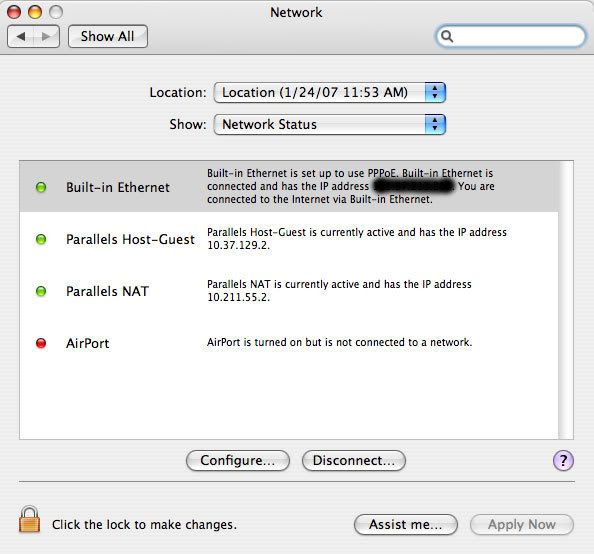
It can be argued that ordinary users need not know of such things. Seriously, not everyone may be inclined to tinker with their PC, but being it their device, having paid for thousands of dollars worth of money, wouldn't it be prudent to leave that option up to end users? The Mac for all its beauty and elegance and made for grandma to ease of use, doesn't dumb down the user--- it presents such network information in a clear way and if grandma doesn't want to look at it, that's great too (see image to your left, pardon, I had to erase my ip address).

The dominance of Windows is undisputed. Corporations and governments around the world remain imprisoned by their reliance on Microsoft products. Where once the mantra was: picking IBM was a no brainer--- it has been usurped by Microsoft. Picking Microsoft for years as your vendor of choice was the no-brainer. No longer is that clear cut.

Times are changing. The move to 64-bit computing leaves a wide opening for people migrating to the new technology. Increased interoperability between documents through open standards like the open document format, is paving the way for Microsoft's dominance to be eroded. The ability to communicate with people on Windows machines--- via such mechanisms like Windows Share/Samba or through OpenAFS or through other groupware collaboration techniques are instrumental for new buyers to consider other platforms like Linux and Apple. The increasing reliability of Internet-based applications like Google Docs and Spreadsheets and groupware technologies and our increasing dependence on our online World is also adding to this shift.

It is fast becoming irrelevant to simply lock yourself on a single platform, unless you happen to have a specific demand for it. Virtualization of the Windows operating system that is allowing Data Centers everywhere to virtualize windows servers, or for users of VMware and Parallels to run XP or Vista on their Macintoshes is further proof that having a PC and being dependent on Windows is no long of paramount concern.

Parallels has a feature called coherence that makes windows and windows applications, look like a native mac application:


What does this mean? Simply: Windows-only applications can run on either Linux or Macs via Virtualization!

The cost of acquiring a PC based Windows computer, and a Macintosh one is now on a 1:1 basis, given the value of both devices. It can also be argued that unless you are proficient enough, in spite of Linux distributions being free, the cost of installing and learning it and figuring things out as opposed to the ease and simplicity of the Mac, may also put Linux in a 1:1 condition with a Macintosh. On one hand, the daring PC user, seeking alternative options can simply download a LiveCD and be on Linux without so much as installing it or learning anything about Linux. And this is an important factor in increasing Linux Desktop share or making people aware of the greatness that is Linux.

Windows Vista faces tough opposition. Sleek, and modern, Vista may look to a lot of people. arguably, it is old news to people who are on Macs and quite recently: Linux. Linux you say? Aren't they the bunch who have such grotesque user interfaces?

Take a look at Sabayaon, which can run on a LiveCD (torrent) with full 3D graphics turned on. That's right, Live-no-install-required-to-try-CD or LiveDVD (torrent). The minimum specs:
  • i686 Processor (starting from AMD K6 and Intel Pentium II)
  • at least 256Mb of RAM (512 suggested)
  • an OpenGL capable 3D graphics card (mostly NVIDIA, ATI, Intel, VIA)
  • a DDC capable Monitor
Play the video to see what a Sabayon Linux can do for your two year old, aging computer:


Arguably, Sabayon isn't a household name, when it comes to Linux distributions. The more familiar is Ubuntu, which is "Linux for Human Beings". (torrents: Ubuntu LiveCD, LiveDVD). Take a look at this Ubuntu video:


Linux and the Mac share pedigree. Both have Unix in their blood. command line based applications used for webservers or developing web applications are easily ported across each other, mostly from linux going to Mac. Many developers on Linux carry and use Macs to develop software on linux!

The added value of going Mac for most people is that it is more general purpose than linux. It isn't every day you code, or write on a word processor or spreadsheet. The life style applications that come freely with the Mac like iTunes, iPhoto, garageband and the ability to communicate with more devices (than in linux) such as digital cameras, scanners and printers make it the greater value choice as a desktop machine. For example, Attorney Renee Mancino is a one woman legal office using her Mac. More and more small businesses are leveraging Macs. The Mac has become the perfect symbiosis between working and playing.

The PC gaming genre is dominated by Windows PCs. DirectX based games make it so much harder for people to develop on other platforms like Macs or Linux where it doesn't exist, even when there are perfectly standards-based frameworks like OpenGL for developers to choose from. That too is changing.

If you're on Linux, and want to play games, chances are you've either tried three things: installed and run wine, which is an implementation of DirectX on Linux, played the many addicting native linux based games or paid transgaming to run games on Linux.

Transgaming is a road to gaming emancipation. Their database of supported games is vast--- including running the latest games like World of Warcraft.

If you're on Apple, Aspyr is a company that have ported popular games, including The Sims 2 to the Mac. Blizzard Entertainment--- makers of the Warcraft francise have always developed for the Mac and their Warcraft III games, and World of Warcraft are native residents of OS X.

Michael Dell has joined the swelling ranks of Linux Users. He is reportedly a user of Ubuntu and quite recently, his company has plans to begin shipping Linux PCs.

There are many who simply refuse to switch platforms because they're intimidated by it. What can we say to users like these? They've got to be encouraged to try either one out. Sometimes, it is also a case of having been living in the dark world of windows, they've lowered such expectations that they work for the computer. it is suppose to be the other way around.

If they've chosen Macs--- they're by far the easiest and best value for your buck.

Productivity tools like QuickSilver and Applescript and smart folders exist on the Mac. They make loading applications or finding data so easy--- just a few quick tap on the keyboard (the mouse is hardly needed in such operation) and your app or data (for example music or a photo) will be opened for you is a prime example of the computer working for you and not you having to mold your way of doing things to the limitation of the computer's operating system.


video from leo laporte's twit.tv network, "Macbreak: Quicksilver"

Summarize--- (click: a Macbreak Podcast on Summarize) a fabulous tool that lets you summarize any text, pdf, document in minutes is especially useful in generating quick executive summaries for reports or you simply just want to get the gist of an article or web page's lengthy gibberish. (don't worry, i won't take it against you if you did that with this post).

Coming from a Windows world, arguably the cheapest way to find out what you're missing is to download and run a Linux LiveCD or LiveDVD. that's right: run, not install. You don't have to install Linux to give it a go. Distributions like Sabayon or Ubuntu lets you experience whats it like without having to install it. the full 3D windowing experience is just a prime example. Each liveCd is normally outfitted with at least a browser and sometimes OpenOffice--- hence you get to do your work.

Like people who switch from Windows to Macs, people who switch from Windows to Linux have expectations that things will remain the same. They bring their windows preconceptions to the table: like device drivers. As Caitlyn Martin explains in Performing Brain Survery on Yourself (a must read for every Windows to Linux Switcher) it isn't the same thing:
Linux isn’t Windows. There are no .dll or .inf files. Those are exclusively Microsoft concepts. Working with Linux (or FreeBSD or MacOS) is an exercise in dropping your ingrained Windows concepts and learning a different way of doing things. That’s precisely what Linus Torvalds meant by “performing brain surgery on yourself”, For some people that initial learning curve is just plain difficult. Nobody said this would be easy for everyone.
It's a whole different and exciting world!

The distributions that have built themselves on top of the Linux kernel are so many, so multifaceted that often you drown in too much choice and information. That characteristic makes it beautiful. The Beauty of Linux is that like the PC before it--- it lets users do what they want to their hardware. They can build a decent car or a supercar out of ordinary commodity items readily available from your friendly local computer shop. There are infinite possibilities in a do-it-yourself environment such as linux. It brings to software, the open-unshackled-form -vendors' mantra that the PC was built on. So much so that you can even build yourself a supercomputer in your garage using Linux. Linux is simply power personified.

The Mac on one hand is the quickest, easiest, way of getting any job done. The easy networking capabilities of the Mac and Xgrid allow Mac users the easiest way to build a compute cluster. From science computing innovation, to cost efficient dicom archiving and viewing, to million dollar presentations, to writing mac based applications to web-based applications, or simply emailing grandma and maybe write that report due on monday together with that keynote you need to finish. It is the perfect device that bridges work and play, makes you look good and it leverages the Power that comes with its Unix pedigree and gives it some finesse.

A lot of people leave windows behind because of the sheer trouble of Bots, trojans, viruses. They won't leave their Windows boxes for these reasons: 1) a specific work application is needed; 2) they believe there is no equivalent mac or linux app that lets them work along side their windows-carrying buddies; 3) they want to play games and linux or the mac don't/wont support what they want; 4) cost; 5) the Mac or Linux look "too high tech", and are frightened by it. We've successfully answered each of those reasons.

Beyond the philosophical arguments of remaining a Windows user, the cost-performance benefit to users to switch is beyond reproach. Still: from across the Americas, to the land down under, from Munich, to Asia, to the heart of Red China, from the Top 500 supercomputers in the world, to financial centers, from ordinary folk, to borrow Mr. Linderman's words: "we have our roles to play in the events to come".

Be part of the Revolution! Arm yourselves with Macintoshes! If you choose, liberate your PCs with Ubuntu! Unshackle them with the Power of Sabayon! The Revolution is taking the world by storm. Will you help bring an End to the Dark Age of Computing? it's time to save the world from the constraints Windows has imposed upon Users. Will you enlist with us?

specific links/resources, if you're in the Philippines:
1. philmug - for all your mac-related questions
2. plug - philippine linux users' group
3. longbeard for all your Mac or PC gear needs.
4. bayanihan linux - if you're feeling nationalistic, it's a linux distribution.

some additional reading/links:
1. forums like cnet.
2. linuxtorrents - all distros
3. 50x15 initiative

Archive