When Running Code in Filipino
This series has been converted to PDF for easy reading:
A wise and frugal Government, which shall restrain men from injuring one another, shall leave them otherwise free to regulate their own pursuits of industry and improvement, and shall not take from the mouth of labor the bread it has earned. This is the sum of good government, and this is necessary to close the circle of our felicities.
-Thomas Jefferson, First Inaugural Address.
In conclusion, a memorandum circular by the National Telecommunications Commission, will be “ultra vires,” or outside its mandate. This document has shown that the Electronic Commerce Act is the more appropriate law to follow in this instance.
The Electronic Commerce Act has clearly defined what is data, how it is received and transmitted and how to secure it. RA 8792 already has laid down the foundation for what is acceptable in electronic commerce in the Philippines and though not explicit, New Media whether it is only about ringtones for mobile phones, fall under this category. The Department of Trade and Industry clearly should take precedence in this matter as it is an affair of commerce and trade.
Hence, why should there be an added expense to deploy “online content”? Why should Government knock itself out trying to police content this way? It is one step closer for NTC to police skype. Imagine how silly it would be to require a license to call your sister on skype. We don’t need a Ministry of Truth.
The dangerous provision of the circular, particularly allowing access to servers without a court order is most troubling. It took 10 years for an Internet-Censorship Act in America to fail and this may be the dawn of an Internet Censorship campaign in the Philippines. Given the political climate and given how much of our people are clueless about the Internet and protecting Freedom of Speech online, it will be a never ending battle, at least in the immediate future. Now more so than ever we need to guarantee Internet rights, which is to say, we need to guarantee freedom of speech and freedom of expression doesn’t get trampled upon.
Thus, there must be a local chapter of the Electronic Frontier Foundation, maybe a Freedom Foundation, organized to help defend free speech and free expression.
What the NTC should be focusing on is how to preserve Network Neutrality, which is of greater public interest rather than this. It should be focusing on how to help the telecom industry migrate to faster wireless broadband. It shouldn’t worry itself over the price of SMS or ringtone, which market forces can clearly thrive in and will serve public interest.
Likewise, Lawmakers should step forward. A rethinking of Defamation Law, of a Freedom of Information Act is needed. We need better protection for free speech and free expression to ensure that the collaborative mechanism that empowers millions online would continue to benefit tomorrow’s generation. After all, the Philippines of tomorrow should never be, 1984. In this, do we have at least, rough consensus?
Acknowledgement
A shout out also goes to @JimAyson and @nicknich3 for pointing out links to Davos. Thanks.
Though this document is my opinion, I would like to acknowledge @jenijenjen, @bigenya, @sofmi, Ding, Nick and the technical staff, contributors and editors of Filipino Voices for their insights and comments.
MIT professor Dave Clark, one of the grand old men of the Internet, may have unintentionally written the IETF anthem in his A Cloudy Crystal Ball/Apocalypse Now presentation at the 24th annual July 1992 IETF conference. Today, it's immortalized on T-shirts: "We reject: kings, presidents, and voting. We believe in: rough consensus and running code." Which might translate to, "In the IETF, we don't allow caucusing, lobbying, and charismatic leaders to chart our path, but when something out on the Net really seems to work and makes sense to most of us, that's the path we'll adopt."
- Paulina Borsook, “How Anarchy Works,” Wired 3.10
Any understanding of what “Internet rights” for the Filipino and for any Netizen for that matter should be drawn from the background of the history of the Internet and the culture that exist around it. The culture born of those early years of the Internet was spawned naturally from the simple and pragmatic design of the Internet, and from the norms and character of academics, engineers, and scientists who were its Pioneers. Naturally, this era gave birth to Hacker Ethics, the GNU Manifesto and the infamous essay, “The Conscience of a Hacker”:
This is our world now... the world of the electron and the switch, the beauty of the baud. We make use of a service already existing without paying for what could be dirt-cheap if it wasn't run by profiteering gluttons, and you call us criminals. We explore... and you call us criminals. We seek after knowledge... and you call us criminals. We exist without skin color, without nationality, without religious bias... and you call us criminals. You build atomic bombs, you wage wars, you murder, cheat, and lie to us and try to make us believe it's for our own good, yet we're the criminals.
- A snippet of “the Conscience of a Hacker” by The Mentor
The 1980s and the early 1990s saw rapid transformation. Steve Jobs was thrown out of Apple and then started NeXT and the computer that he made at NeXT would host first Webserver. By 1991, Linus Torvalds wrote the first lines of the Linux kernel powered by an Internet largely used quietly by academics, engineers and scientists would unwittingly change how the world would be. Two years later, as IBM lay dying, Bill Gates proudly won the Operating System War.
Netscape, Yahoo and Red Hat were quietly born and as Windows 95 sealed Microsoft’s dominance, Netscape went public, its stock skyrocketing to US$75.00 and the World Wide Web began to enter the general public’s consciousness.
The Years, 1997 and 1998 were crucial. Microsoft had a lock in with just about every company in the world, even the mighty juggernaut named Intel. There were many things happening in the background. Intel wanted in on a little company called Red Hat that sold software on Intel that wasn’t Microsoft’s Windows. Then there was Netscape, which was struggling to compete against Microsoft in the browser wars. As a company that made money selling browsers, Netscape could not compete with the price that Microsoft had for their Internet Explorer: US$0.00.
Enter a guy named Eric S. Raymond.
Eric S. Raymond was a software developer who wrote an essay “The Cathedral and the Bazaar.” This essay compared two methods of software development. In the Cathedral Model, the source code: the DNA of an Application was restricted to an exclusive group of developers who wrote it. The second, the Bazaar model popularized by Linux, the source code could be seen, edited and worked on by N number of people without restriction. This essay helped persuade Netscape to give away the source code to their Internet browser and thus the Mozilla (Firefox) project was born.
This was significant.
Hacker culture had entered the world of Business. Everything changed. Hacker culture was powering Big Business. Intel went in bed with Red Hat Linux, helping funding that fledging company. Apache Webserver, another open source project came out of the closet. Where once only a few hackers around the world knew, businesses started funding these projects. IBM and Intel just to name a few have committed engineers to work on the Linux kernel, to ensure that their machines ran on Linux. Suddenly you have an Internet that was running off Open Source.
No one owned this code? It was frightening. It was unheard of. Companies were giving away the very recipe of your software. You are giving your competition an advantage. Suddenly Business doesn’t own the software. It was completely insane. Suddenly anybody could create their own version of your software. This spurred more development on the Web.
Software of all sorts could be downloaded off the web and leveraged by anyone. The Second Coming of Steve Jobs saw Apple building Mac OS X on top of BSD Open Source software. Nearly everyone uses open source software today, in one form or another. IBM is a company that bundles open source software in their business, apache being one of them. They also sell Linux servers, for instance.
The tech bubble at the turn of the century, saw the industry in a slump. People who got fired started blogs and all of a sudden the Internet exploded with content. As bandwidth increased, blogs were followed by podcasts and we find ourselves today at the dawn of video podcasting. New Media was transforming how we are entertained, how we get news, how information is conveyed.
Fast forward to the end of 2008, The Philippine blogger community had found its voice. The controversy surrounding the De la Paz incident made its way from blogs to the International press. The power of the Internet becomes frightening.
Like many across the world questions on what exactly constitutes blogger rights and free speech online is being debated. Court cases from America form much of this literature as well as laws like The Digital Millennium Copyright Act and locally the lawsuit filled against the PCIJ and as this new threat from the NTC comes out, more people find themselves communicating online.
The point I was trying to make mentioning Hacker ethics, and “The Cathedral and the Bazaar” that in every instance when Online Life had a turning point, the core principles of sharing, openness, decentralization, free access to computers and networks, and general world improvement was there.
The same core principles permeate social networking, whether you Facebook or you twitter. Whether you blog or you flickr. Whether you podcast or YouTube, at the core of it all are those values. Everything from the Internet Engineering Task Force to forum, or every kind this community ethos is part of it. Even the idea of Net Neutrality takes its root from this inalienable qualities that make the Internet such a wonderful resource.
We’ve seen the failure of Digital Rights Management. The music studios have given up on it by letting DRM free music downloadable on iTunes and on Amazon.
Many of the salient provisions for a fair and free Internet in the Philippines is already existing with the Electronic Commerce Law. The biggest hurdle is to decriminalize defamation law in the Philippines. The next is a clear and present need for a Freedom of Information Act and access to media records that is both fair, open and transparent. This isn’t just for “Internet rights” or for bloggers alone. It extends to governance. It extends to how we view our society. For a democracy, our country sure tries doubly hard to make things illegal. For a democracy, we contrain truth and logic.
Don’t you feel that everyone is so distrusting of one another that the air is so poisonous?
Then there is Creative Commons. Seriously, why aren’t more people tagging their material using Creative Commons? Whether you photo blog or video blog or podcast or blog, or have a recipe for your salad, tag it. In my humble opinion, as much as Open Source licenses have empowered businesses, so too can Creative Commons empower and emancipate information for the rest of us.
Creative Commons lets people know how far you can go. It gives a framework for sharing, for being open, for free access to information and in the tradition of the Internet, it makes a whole lot of sense. It liberates your Intellectual property material in the same way Open Source has liberated source code.
When someone infringes on Creative Commons, those cases need challenging because there needs to be precedent that it works.
That said, there is a clear and present need for a non profit Freedom Foundation that serves not just as the local chapter of the Electronic Frontier Foundation. It becomes a one stop shop to know how far one can go while blogging or who do you quote for image rights or text and everything else in between. Hey, legal cases are expensive in the Philippines and challenging and protecting our intellectual property, more so when you license it freely and someone abuses that right is challenging. All of it requires expertise, money and organization.
Muad'Dib could indeed see the Future, but you must understand the limits of this power. Think of sight. You have eyes, yet cannot see without light. If you are on the floor of a valley, you cannot see beyond your valley. Just so, Muad'Dib could not always choose to look across the mysterious terrain. He tells us that a single obscure decision of prophecy, perhaps the choice of one word over another, could change the entire aspect of the future. He tells us "The vision of time is broad, but when you pass through it, time becomes a narrow door." And always, he fought the temptation to choose a clear, safe course, warning "That path leads ever down into stagnation."
- from Arrakis Awakening by the Princess Irulan
The recent World Economic Forum had a session, “The Next Digital Experience [video],” hosted by well respected blogger and TechCruch Founder, Mike Arrignton. The panel included Chad Hurley of YouTube, Mark Zuckerber of Facebook, Shantanu Narayen of Adobe, Hamid Akhavan of T-Mobile International, Eric Clemens, Wharton, and Craig Mundie of Microsoft. They talked about the future of mobile and the next digital networking experience.
In that session, Hamid Akhavan of T-Mobile International was quoted by Businessweek:
3.2 billion people have mobile phones. Most widely held electronic device. 5% only are browser capable for an internet experience. In Western Europe, with net-capable phones, data traffic is rising very fast. (emphasis mine)
Another interesting point was raised by Clemens about the difference between push and pull technologies (I paraphrase):
“There is a huge difference between a push or pull. If someone pushes information about a restaurant and I can’t even use my phone because I’m being bombarded with information, that’s the wrong model. ...If I want to know where my friends eat in Chicago and I pull that in, that’s incredibly useful.”
This is existing right now. Mobile Phone carriers not just Globe and Smart are constantly bombarding users via SMS about advertising. That is Push. Clearly the twitter model of “asking” (Pull) of seeking out the data for you. That’s the less intrusive. It is clearly the model that users like. This is something mobile phone companies and technologists need to think about and integrate.
Clearly as much as the Internet has transformed the world, it continues to be a nascent technology. It is a nascent industry. Everything is still growing.
The infrastructure of the Network which includes everything from cellular technology, wireless internet to the wired lines, cable, DSL and other similar technologies, are clearly owned by the telecommunications companies and thus is under the NTC. Making this affordable, reliable, and ensuring Network Neutrality for not just government but every Filipino is a mandate that the NTC needs to uphold.
Perhaps we ought to take a page from Korea. How do you broadband? Korea’s Communications Commission answer:
“...the newest move by Korea’s Communication Commission is planning on a countrywide broadband upgrade. The country already has one of the best broadband penetration and speed in the world and they plan that by 2012 it will be getting a whole lot better. How much better you ask – well try a 10 fold increase in speed.”
It isn’t just with Korea. Obama intends to build a broadband infrastructure to rival the US Interstate System:
President-elect Barack Obama vows to "renew our information superhighway" as part of a massive plan to invest in public infrastructure and stimulate America's flagging economy. Obama's immediate plans include large federal investments to bring computers and Internet connections to school districts and the health care industry.
As the world will be a digital tomorrow, a broadband infrastructure whether built by Private or Public enterprise must be coupled with intensive teaching and training to get people to see beyond mere friendster and mere yahoo email as the Internet. There is a need to show Filipinos the deeper magic of the Internet. To leverage social networking platforms like Twitter and Plurk, to journey past and see what technology, entertainment and design has to offer. To see the wonders of the Web and the beauty of its underlying infrastructure and culture. There is a clear and present need to ensure Filipinos can leverage the Internet and this must be coupled with a codified “Internet rights.”
We need to be able to bring Filipinos onto the greater web and if Cellular technology has shown us, it is through rapid expansion in the mobile space that this needs to be done. The first personal computer of tomorrow’s Filipino ought to be on the mobile space and we must participate in ideas like Rethinking the Internet.
Eric Clemens says, dogs instantly know what’s in a room. That’s the power of their senses. Clemens says that with the amount of information we’re having, that’s available right now, we’re like dogs. Mobile and the Network is giving us hyper-reality. He makes a note that Young Wall Street bankers on two sides complete deals on Facebook because they were old college roommates. This is something that Future Filipinos need to get into. This hyper-reality, this hyper access to information is astounding.
There is a push at the United Nations to make Internet access, a human right. If that should happen, the National Telecommunications Commission must be one of those agencies to ensure that right. It can guarantee it by ensuring Net Neutrality. The NTC can ensure fair and equal and healthy competition between Telecommunication companies, exist.
There is also the question that the Internet will become a utility one day. It is not a farfetched idea. It is an idea that has merit and the infrastructure will still fall under the watchful eye of the NTC.
The Electronic Commerce Act of 2000 has defined what data is, how it is received and transmitted. It defined how to secure it, explicitly but the Law is silent on “Internet rights.”
The CIA’s factbook says there are over Five Million Filipinos online, and as this number is growing. We now have 5 million people whose rights to freedom of speech and freedom of expression is left ambiguous. The idea that the Internet is a right has merit. It must be something lawmakers must debate today. Tomorrow, we will clearly need an understanding of what rights do we have online. Do we need “Internet rights?”
To the future or to the past, to a time when thought is free, when men are different from one another and do not live alone— to a time when truth exists and what is done cannot be undone: From the age of uniformity, from the age of solitude, from the age of Big Brother, from the age of doublethink — greetings!
-George Orwell, 1984
Five stories. I gave you five fictitious scenarios that did not require any business relationship with a telecom provider, save that in each instance the parties involved were subscribed to use the telecom's internet offering or should they require a static IP address. They were five stories of intelligence that exist at the end point of the network.
Of course no one is stopping a telecom provider from offering their own music store or to sell videos and goods online or doing any of the above business.
Could you see:
How New Media translates to mean that anyone can be both content provider and content developer, and thus blurring the line between producer and developer?
How counter productive it is to subject online content to a licensing fee?
How diverse the definition of content is, and
How this, including mobile phone content is already governed by The Electronic Commerce Act and ergo the primary agency ought to be the Department of Trade and Industry. As clearly all of it is a matter of commerce and not mere telecommunication infrastructure.
The commission, perhaps it thinks it is acting in the public's best interest when it wrote about rates:
“The rates shall be deregulated. The contents, information, applications and/or electronic games provider shall inform the Commission of the rates for each of the content, information, application or electronic game offered at least three (3) days prior to the offering of such content, information, application or electronic game. Contents, information, applications and/or electronic games providers seeking increases in rates shall inform the Commission of the details of such increases at least five (5) days prior to the implementation of the increase. The Commission in the exercise of its mandate to protect consumers may not allow the increase. If the Commission does not act on the information within five (5) days from receipt of the same, the contents, information, applications and/or electronic games provider can impose the new rates.”
Even if it were under their jurisdiction, when The NTC wrote the rates were to be deregulated, it completely overturns this when it says, “To protect consumers, the commission may not allow an increase” and goes so far as to say that content developers can impose new rates if the commission ignores their adjusted rates.
Clearly the National Telecommunication Commission does not wish for a deregulated industry.
Why should government impose such restrictions? Is it an attempt to make more money? Ergo this law becomes a form of taxation?
I argue that the even the price of SMS and the fees associated with it isn’t under the NTC but under the Department of Trade and Industry.
Is it out of fear that a telecom for instance would raise rates on text messaging? A person could either choose to pay the higher SMS cost, or not at all. That's the nature of the business isn't it? It isn't life or death not to send out a text message. Neither is it life or death for someone to download a ringtone or game.
Either you have the money to pay for it or not and if fewer people used the telecommunication's service then, that's the telecommunication company’s problem isn't it? They're a business and should know how much the market will be willing to pay for a service or good. They teach those things in business school do they not?
What the commission is proposing will not serve the market place at all. It is a hindrance to real competition between the telcos and content providers and content developers.
What happens when lifecasting comes to the Philippines? That’s right, how do you “regulate” Qik for example that lets you share live video from a mobile phone?
While the Electronic Commerce Act under section 41, has mandated the National Telecommunications Commission, among other implementing agencies “to aggressively formulate, promote and implement a policy environment and regulatory or non-regulatory framework that shall lead to the substantial reduction of costs of including, but not limited to, leased lines, land, satellite, and dial-up telephone access, cheap broadband and wireless accessibility” by government and the general Public.
Why is there such a blatant disregard for a free market?
Networks, systems and/or facilities providers shall provide access to contents, information, applications and/or electronic games providers upon request and based on an access agreement. Access to the networks, systems and/or facilities of duly authorized providers by registered contents, information, applications and/or electronic games providers shall be mandatory.
If taken benevolently could be interpreted that each telecom would provide each other access. That network interoperability should exist. That it only pertains to telecom companies.
Taken or interpreted differently it simply means government without even going to a court of law could ask for the content of a server. It could require access to servers and files just about anything, just like that. No telecom, however evil should be subjected to such process.
In the wrong hands, such act is powerful, and detrimental to free expression, free speech and privacy.
No government or person should have that power without due process, without going to legal processes like a court of law, no matter how rubber stamp such process could be. The level of abuse this could lead to is unimaginable. Suddenly, private family photos and private email could be opened just like that.
Even email.
Even confidential corporation information.
What about the NTC regulating the cost of doing business?
The access charge shall be negotiated. The access charge shall be cost-oriented and shall not be higher than the prevailing retail rates, not promotional rates, for the service where the contents, information, applications and/or electronic games are offered/provided.
While the Electronic Commerce Act allows the NTC to provide a regulator or non-regulatory framework, with respect to the infrastructure, to determine the cost for content developers, I believe is outside their mandate and for any agency to do so, is equally wrong. The NTC isn’t the Ministry of Truth.
The iTunes Music Store
Take the case of Apple’s iTunes Music Store. This music store serves the iPhone. Similar stores for Google Android and Palm are available. The iTunes model, which applies to both Application and Media (both music and video) the price and revenue sharing is clearly between Apple (the provider and owner of the store) and the Content Developer (the Music labels, the musicians, the Movie and Television studios).
Clearly, the matter between the content developer or the applications developer of not just the Mobile Phone segment, falls under the same category as the iTunes Music Store. How it is priced or how revenue is shared is no one’s business except the business entities, both free to negotiate their transaction. Should it be cost oriented, revenue sharing or whatever other method, shouldn’t that be up to them? It is a business decision that government should not interfere. To take that away from the market place where government clearly does not need to step in to regulate is a mistake. I believe to regulate this industry would go against the policy to promote Electronic Commerce.
As to the point where the NTC would like to license just about every content, as we’ve stated the definition of content is so broad and sweeping that it encompasses different industries and genres that the Electronic Commerce Act already covers superiorly. Not to mention the utter futility to subject every content to a license and how detrimental such activity would be.
Richard Edelman wrote about A Different Davos and he talked about the conundrum of media:
Conundrum of Media—At the Media and Entertainment Governors session, there was little consensus on a way forward. Distribution is the new hot area (YouTube is now the #2 search vehicle); content, which was king, now is not. There is expectation of free content, which may well mean more consumer-generated and aggregated material improved by democratization. Media companies must provide a “live” experience, allowing more continuous updates. Subscription models, such as Thomson Reuters, only work because they are aiming at professionals with inelastic demand for high-grade material at their fingertips. The display model for advertising is broken; the ad agencies need to find better ways to reach specific audiences through more targeted, measured advertising.
The intelligence aspect of the network, should be under the watchful eye of the Department of Trade and Industry while the underlying infrastructure, how telecoms do business falls with the National Telecommunications Commission.
Intelligence on the Network
I give up on the puzzles. I just want to turn the page upside down and read the answers.
- Evey, V for Vendetta
Let me introduce to you John dela Cruz, his wife Maria and Patrick Reyes. John lived and worked in California. His wife and son resided in the Philippines. John was an Overseas Filipino Worker. He worked as a Male Nurse in California but is a computer enthusiast. He not only knows how to develop web applications but is familiar in building a web server. John dela Cruz had long since dreamt of becoming an entrepreneur and with a growing son, decides, his family would need more income.
So John, in his spare time slaved away, writing a store application that would let customers in the Philippines buy and sell clothes from sports wear to formal wear to underwear. He knows how to build a web server and knows the cost of outsourcing it to a hosting provider. John being cheap, thought, "Well maybe, I'll do my own hosting". He computed the cost of high speed internet to his house in California, the cost of running a computer Twenty-four-seven and the time it would take to maintain it. In his due diligence he noted that, “Yes, he could run this on his own". At least while the business was young.
So John goes out and buys a cheap computer from the local Best Buy. Being a geek, he naturally is familiar with how to install and configure open source software: Linux, Apache, MySql, and PHP (LAMP). After which he gets his local ISP to give him a static Internet Address. John registers a domain name and points it to his brand new server. Maria in the Philippines already has a computer and is running off a broadband connection and which comfortably rests in their family living room.
After testing his software, John registers the business with California.
Now the store's about to open. John a month previous had already bought his inventory. It was shipped to Manila by sea and his wife had already received his freight and paid for the appropriate taxes and duties. Days later, John opens the site to the general public. The store after a brief outage, is running smoothly.
Through the marvel of the Internet, Maria is log on to the online store in California. Once a customer orders, the software will tell Maria that, yes, you may now ship the product because it was already paid for.
Patrick Reyes is a lawyer. Now he wanted to buy his new girlfriend something nice. A friend of a friend told him that hey, there is a new site that just opened that would sell cheap clothes from America but half the local price. Curious, Patrick goes online and sure enough finds John and Maria's PinoyRTW.com and while browsing the catalog found it drastically cheaper than buying the same thing from Shoemart. Oh, wow, Patrick thought, the site also gives free shipping and free wrapping/packaging. It was too good to be true, Patrick thought.
Boom!
Maria receives confirmation that it was time to ship a cocktail dress to Patrick Reyes, which was supposed to be neatly wrapped in a red box. The package was supposed to be delivered at Enterprise Center in Makati. Maria after wrapping the package, takes the public FX and the MRT and an hour later had already hand delivered the package. Thirty minutes later, Patrick's new girlfriend Jessica and a dazzling smile painted on her face.
Five years later, John and Maria's business had evolved and they were now shipping to every part of the world and most of their clientele is Filipino.
The broad and sweeping definition of the NTC clearly includes John dela Cruz as Content Provider and Applications Developer.
Again, let us briefly return to the NTC’s definition:
“Contents, Information, Applications and/or Electronic Games Providers, Contents Developers, Information Sources, Applications Developers, and Electronic Games Developers are required to have commercial presence in the country and shall secure Certificate of Registration (COR) from the Commission.”
John and Maria's business undoubtedly has a commercial presence in Philippines. From the get go, it is a multinational corporation. And as per this proposed Circular, not only would John and Maria be required to register it with the NTC, not counting of course other local license fees that they ought to apply for it doesn't make it easy for a Filipino to start a business.
According to the Electronics Commerce Act, Section 3, subparagraph d:
“Neutral Tax Treatment. Transactions conducted using electronic commerce should receive neutral tax treatment in comparison to transactions using non-electronic means and taxation of electronic commerce shall be administered in the least burdensome manner.”
Atty. Jesus M. Disini, Jr., wrote an annotation in the book, The Electronic Commerce Act:
“Taxation of Electronic Commerce. There are to date, no explicit Philippine tax laws on electronic commerce and it appears that no law will be passed on this subject matter in the near future. However, it is undeniable that many of the activities involving electronic commerce are subject to existing tax laws. For example, retail goods over the Net would attract value-added taxes (VAT). Additionally all electronic commerce entities located in the Philippines would be subject to some form of income taxation, indirect taxes, and even local government taxation. The goal of the policy is to encourage the taxing authorities to treat electronic commerce entities no different from the brick and mortar counterparts. Again, this is viewed as promoting the growth of electronic commerce.”
As a multinational business, John and Maria’s enterprise exists on top of the infrastructure and rightfully this operation falls under the Department of Trade and Industry. What tariffs and taxes, duties, transactions and licenses they need to procure to do business in the Philippines and to operate in California, clearly is a business matter that has nothing to do with the network and the Electronic Commerce Act rightly recognizes it and places the governance of it with the Department of Trade and Industry.
II. The World Class Chef
Want to be an Internet superstar? Kara Chen was a gorgeous Chinese-Filipina. The Chens weren't rich but of middle income. More than her drop dead gorgeous looks, at the age of 15, she was the family cook. She could make the most delicious dim-sum to rival dim-sum from Hong Kong. By the time she was 18, she was such a cooking prodigy that she decided to open up a video blog.
Using the family home video cam, with the aid of her dorky little brother Carlos had setup a makeshift studio at their family's little kitchen. As a videographer, it was Carlos’ job to edit his sister’s show. As for the website, the Chen siblings turned to Carlos’ best friend Zac, who having a crush on Kara provided his services for free.
Neither Zac or the Chens could afford to build their own Electronic Commerce site, so rather than build that infrastructure, they chose to use iTunes as the platform.
Kara's Kitchen became an Internet success.
Weekly, numbers began climbing from a handful to a thousand. They didn't want to price too much nor too little, they settled on US$1.99 for the 5 to 10 minute show was more than enough to pay for the cost of uploading content to the internet, having revenue sharing with Apple and making money for themselves.
Kara, Carlos and Zac could now afford to go to university on their own.
This video could be downloaded on any computer and viewed on an iPod or iPhone and yet viewed from the perspective of the NTC, clearly they fall under the definition of content provider and content developer.
The idea that Kara’s Kitchen couldn’t be taxed or “regulated” is a myth. iTunes clearly has a Philippines store. User access is granted and government entities may be able to tax Kara’s Kitchen. The Electronic Commerce Act has already laid down that it can be subject to the same taxation as brick and mortar business is. Fundamentally, there is nothing wrong with that.
Kara’s Kitchen may not be regulated like a ratings agency regulates what gets shown on television. To subject a show like Kara’s Kitchen to online licensing is a mistake. It would simply force the content owners to move the show to a part of the web where in they need not be subjected to Philippine law. Content owners and Content providers will simply circumvent a rule or law that tramples on their right to free speech and free expression. It would be different of course if the store wherein Kara’s Kitchen exists on doesn’t have a Philippine presence. The lawyers can nitpick on it. That doesn’t solve the problem, does it?
The danger that the NTC proposal raises is the trampling of those inalienable rights. What this therefore calls upon is a formal codification of Internet rights.
III. Father Peter Ochoa and the Word of God
The Internet has been a playground of Liberalism. How can it not when the very DNA of the network is one about openness and sharing? Every porn under the sun has a place on the World Wide Web. Just as equally, even faith and belief of all sorts can use the Internet. So let me tell the story of Filipino Reverend Father Peter Ochoa. Father Pete was a natural born evangelist and he used this talent for the Roman Catholic Church. When he spoke, you'd listen and make sense. In the old days, that would mean Fr. Pete would have had a radio program. One day, Fr. Pete got a chance to listen to Leo Laporte of TWiT.tv.
Leo Laporte is the founder of the TWiT network which is totally based on the Internet. He sends out a podcast a day on various topics from technology panel discussion to science to law to family. Being a podcast, the listener downloads it and listens to it anytime he would like. It is like having a radio program that you can choose to listen to anytime you want.
Suddenly, Fr. Ochoa had an epiphany. OK, it was something that came to him and he said it was a blessing from the Holy Spirit.
So he started a religious podcast and the faithful whether Filipino or American, Japanese or Chinese, European or Middle-Eastern or African started to listen.
Sure it wasn't a huge following. It started with a 1,000 who would download his podcast. For every person who downloaded his podcast, they would "donate" at least a dollar to Fr. Peter's paypal account. He would receive proposals to have advertising on his show, which he accepted. Mostly it was from people who sold religious items like books and candles and stuff like that.
Suddenly Fr. Peter found himself earning thousands of dollars a month.
Fr. Peter would record his podcast in the Philippines. He is both provider and content creator. His content is hosted in an American server. His viewership is global. Did I mention that a podcast could be downloaded to a phone just like any ringtone or music? Does this mean he would have to register with the National Telecommunications Commission? Isn’t religion not taxable under Philippine Law?
IV. Application and Game Development - Sudoku for Android
Megan San Miguel was very good in Math and she was very good with programming. Her rich uncle from America gave her a hand me down Laptop and a hand me down cellphone. Luckily it was a Google Android-based phone. Being good with math and programming, Megan wanted a Sudoku for her phone. So she wrote one. Believing in the power of open source, she even licensed the game and code under the GNU Public License.
Then she thought of putting up the software for sale. So asking seed money from her rich uncle in America, they registered a domain name, had the site hosted on a server in New Zealand. Hey, pretty soon she had a steady income and went on to write more software.
Megan also setup shop with the Android Market.
If the NTC interpretation was in place, she'd be doing the work illegally, wouldn't she?
V. Byte and Kagat
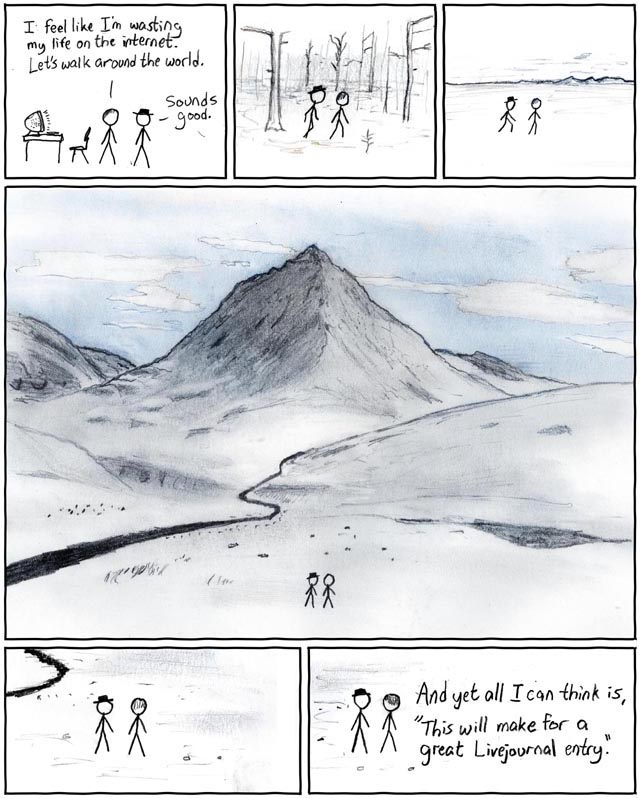 Ryan Ramos was a huge fan of xkcd, a webcomic of romance, sarcasm, math and language. So when Ryan wanted to enter the genre of blogging, he didn’t want to be the quintessential political blogger. Instead of writing prose, he chose to draw satirical comics that reflect the life and times of the Filipino. Think Pugad Baboy but on a blog and instead of polgas, Byte and Kagat were cats.
(Permanent link to image to your left is here.)
His comics through technology called "really simple syndication" or RSS could easily be downloaded on a mobile phone. Which was quite all right with Cathy Ermita who being into politics and satire and humor would be able to download the new comic religiously.
Ryan is both an information source because of his commentary. He is also a content developer and content provider and a New Media practitioner. Part of his website is a page where you can order T-shirts, mugs, and other similar items that allow people to send him money to keep making political satirical comics as his way of blogging.
How again are these scenarios different from ringtones, music, video clips associated with Mobile Phones and Telecommunication Companies?
About a decade ago, in the mid-1990s, just about the time when this post-communist euphoria was beginning to wane, there emerged in the West another “new society,” to many just as exciting as the new societies promised in post-communist Europe. This was the Internet, or as I’ll define a bit later, “cyberspace.” First in universities and centers of research, and then throughout society in general, cyberspace became a new target for libertarian utopianism. Here freedom from the state would reign. If not in Moscow or Tblisi, then in cyberspace would we find the ideal libertarian society.
The catalyst for this change was likewise unplanned. Born in a research project in the Defense Department, cyberspace too arose from the unplanned displacement of a certain architecture of control. The tolled, single-purpose network of telephones was displaced by the untolled and multipurpose network of packet-switched data. And thus the old one-to-many architectures of publishing (television, radio, newspapers, books) were complemented by a world in which anyone could become a publisher. People could communicate and associate in ways that they had never done before. The space seemed to promise a kind of society that real space would never allow—freedom without anarchy, control without government, consensus without power. In the words of a manifesto that defined this ideal: “We reject: kings, presidents and voting. We believe in: rough consensus and running code.”
- Lawrence Lessig, Code 2.0
This is an awakening. Since the first packet traversed the Internet, a debate has raged between norms prevailing between Cyberspace (that ethereal “place” between fiber optic lines, and wifi, where the Internet exists) and how such universe relates to Real Life. Often, the Ethos of Online Life finds itself disjointed with Real Life. As a sub-genre Netizen of The Internet, Filipinos in all strata of Real Life are awakening. Quite naturally, they’ve woven threads online, asking questions of what the Internet is, and what it means for them. Threads like what blogging is, and what New Media is, notwithstanding, are just some of those questions. This search for an Interface between what is acceptable online and what is acceptable in Real Life requires an elusive Rosetta stone.
Take for example how the Philippine Government and its Law recognizes the Network and all the gifts associated with it is likewise being debated and its implication for the future of what the Internet means to the Filipino is equally diverse and more so important.
The National Telecommunication Commission on 22 December 2008 issued a draft memorandum circular that pertained to GUIDELINES ON THE PROVISION OF CONTENTS, INFORMATION, APPLICATIONS, AND ELECTRONIC GAMES all in pursuant to RA7925, Executive Order (EO) No. 546 series of 1979:
WHEREAS, the 1987 Constitution fully recognizes the vital role of communications in nation building and provides for the emergence of communications structures suitable to the needs and aspirations of the nation;
WHEREAS, the promotion of competition in the telecommunications market is a key objective of Republic Act No. 7925 (RA7925, for brevity), otherwise known as The Public Telecommunications Policy Act of the Philippines, which mandates that “a healthy competitive environment shall be fostered, one in which telecommunications carriers are free to make business decisions and interact with one another in providing telecommunications services, with the end in view of encouraging their financial viability while maintaining affordable rates.”
WHEREAS, RA7925 further defines the role of the government to “promote a fair, efficient and responsive market to stimulate growth and development of the telecommunications facilities and services”;
WHEREAS, the provision of contents, information, applications, and electronic games to the consumers creates demand for telecommunication networks and services – the development of contents, information, applications, and electronic games should therefore be encouraged and facilitated;
WHEREAS, the entry of more contents, information, applications and/or electronic games providers in the market will result to lower prices benefiting the consumers;
WHEREAS, to further encourage the development of contents, information applications and electronic games, the prevailing access charge regime between the contents, information, applications and electronic games providers and the networks providers which is revenue sharing should be replaced by fixed access charge;
WHEREAS, in the power sector the consumers can purchase their power requirements from independent power producers – power producers are not subject to nationality requirement;
I humbly submit that this proposed guideline is contrary to the stated goal that the National Telecommunication Commission (NTC) hopes to achieve. The implication of this broad and sweeping scope that the NTC wishes to engage in, whether intentional or not, will not be limited to telecommunication companies and the content provider businesses for those telecommunication companies. It encompasses multiple industries and genres the NTC may or may not be aware it is threading on. It tramples upon cultural norms of Online Life. As such, this broad and sweeping scope would be detrimental for the Filipino and places a roadblock to further the Filipino dream of going beyond poverty. It will dampen innovation and competition in the market place. It will lay added burden on the lowliest content creator, stifle free speech and expression and chain the creativity and intelligence and culture of the Filipino.
This isn’t to say that the NTC has no role, rather it is going about it the wrong way. Neither is it to say that there isn’t any sort of control or regulation governing Online Life.
There exist already a salient Law serving as a foundation to answer many questions the Filipino has, and how to couple real life and the Internet, and that law is Republic Act 8792 or The Electronic Commerce Act of 2000.
For example, RA 8792 has already defined what data and document is. What is data and document but an aging term for content? What is content if it does not embrace not just New Media but Applications too? Surprisingly we find Law such as the Electronic Commerce Act of 2000 which has already defined what the network is, and what devices exist that is part of the network. Particularly, Section 6, subsection (f) states that:
“Information and Communications System” refers to a system for generating, sending, receiving, storing or otherwise processing electronic data messages or electronic documents and includes the computer system, or other similar device by or in which data is recorded or stored and any procedures related to the recording or storage of electronic data message or electronic document.”
Clearly this law intended to include the mobile phone, the network associated with it and all content and application made for that phone. The law is quite clear on what constitutes a network and what data is and who should govern it and penalties for those who hack the network.
Perhaps the NTC doesn’t understand with the Internet, telecommunication has changed. It is a genie that cannot be put back in the bottle save perhaps a catastrophic and global collapse of The Network.
Telecommunication Companies are fast evolving into Internet utility firms in the same way as Power and Water are utilities and as telecommunication has always been. They provide the underlying infrastructure that connects the network. They are like Power and Water companies responsible for pipes and cabling.
The content, the data and documents that travel to and from this extensive infrastructure network is vast and transformative that to impose control and regulation as governments and as the Old Way know it, simply is detrimental to the very nature of the Internet and its ethos and utterly futile.
As Lessig in Code 2.0 points out, that isn’t to say there aren’t any new forms of control that uses the very code running on the network to shepherd packets, to identify who is who, to reduce anonymity online. Because the situation may require of it.
When once the Network was all about anonymity, with increased malware on the network, with electronic commerce, with the arrival of social networks, an open culture utterly requires a definitive identity online, when once chooses to be. We’ve built technologies that regulate the flow of information to how much privacy we want it to be.
Today’s netizen wants to be seen, wants to be known. He wants his name on top of a Google search. He wants to be a Twitter elite. She wants as many friends on Facebook and on Flickr, and millions of views on YouTube.
As much as this is happening, an increasingly number of people are going private with their lives online. No one wants to wash dirty laundry in public, do they? Suddenly, it isn’t such a good idea that everyone know everything there is to know about us. Who knows if a sex video might find itself in the hands of a potential employer?
That’s a form of self-regulation that governments need not impose.
It isn’t to say the original ethos has been destroyed. It simply has evolved. Take Blogger’s rights, and Coder’s rights, even the nature of Electronic Commerce, of Open Source Software design, of Social Networks, at their basic core, still have on their DNA what Stephen Levy wrote on Hacker Ethic. Hacker’s Ethic is all about sharing, openness, decentralization, free access to computers and networks, and general world improvement:
Access to computers and anything which might teach you something about the way the world worlds should be unlimited and total. That all information should be free.
That there should be decentralization where a free exchange of ideas and information is paramount.
Degrees, age, race, position are meaningless and that a system of meritocracy exist;
That art may be created on the computer;
That online can change your life for the better;
The profound changes the Internet has done for human civilization simply isn't limited to print, radio, video, or in how the world communicates. The Internet has had a profound affect on discovered and invented information and technologies most importantly in how they are applied. It has had transformative effect on how governments can communicate with their people, and more important with how much and how deeper people can communicate with one another. The changes are simply astounding and unquantifiable.
The Internet has a drastic affect in everything, from business to culture, from literature to every form of entertainment. It has hyper-enabled every discipline in academe, on research and development in universities and in corporations and brought this power to the basement and garage of every home in the world, immensely.
This beautiful and wonderful technological achievement is so nascent that we do not know how profound it would affect every person's life from here on out. This transformation in how we communicate has made the world closer as much as the jet engine has made the world a smaller place. The total cost of communication when once it took much money simply to call a person Manila to San Francisco has been drastically reduced. Today, anyone is a skype, google talk or yahoo messenger away. To further a point, the marriage of computer and the Internet is the first video phone that many had dreamt we would have mere decades ago.
Not since Gothenburg and the rise of the printing press has there been such an explosion of information and communication.
This beauty came about because of the End-To-End design of the Internet. Pragmatic, the underlying infrastructure is of end-to-end network design that an agency like the National Telecommunications Commission ought to understand. This design philosophy that brings intelligence away from the infrastructure and to a higher plane or applications level permeates life on the Internet. To make an analogy, the NTC is to the infrastructure as the Department of Trade and Industry is to Electronic Commerce running on top of that infrastructure. It is the Internet Engineering Task Force is to the infrastructure (Cyberspace) as the Rest of us is to the Internet running on top of that infrastructure or existing on Cyberspace.
Definition of Terms
For the sake of this discussion, we shall follow the same terms the National Telecommunication Commission uses:
To bring my point across, I shall try to use fictitious scenarios but before I do that, let me introduce a term: New Media:
“New media is a term meant to encompass the emergence of digital, computerized, or networked information and communication technologies in the later part of the 20th century.
Most technologies described as "new media" are digital, often having characteristics of being manipulable, networkable, dense, compressible, and impartial.[1]”
- New Media on Wikipedia.
Does that term and its meaning sound overtly familiar? Does it not encompass all things that the NTC wants covered?
Simply put, Content and Application is the intelligence existing at the endpoints of the network. So what intelligence exist on top of the network infrastructure?


 Posts
All Comments
Posts
All Comments


