How many Microsoft minions would it take to screw a light bulb? There are none: Bill Gates commanded that darkness rule the Earth. With his proclamation, the Dark Age of Computing began.
Rejoice! The clouds are parting, light is shining through! Isn't it a joy to hear the good news? The Dark Age of Computing is coming to an End!
Wait--- we're in a dark age?
Kidding aside, it certainly doesn't seem like that, you say?
It was Alan Kay who was quoted saying: "People who are really serious about software should make their own hardware." For most people, software is about
Microsoft Windows and PCs. The status quo is that they buy from
Dell or
HP, or build-to-own-white boxes from their friendly neighborhood computer shop for their hardware needs and they come with Microsoft Windows.
Yet Windows has spawned mediocrity in software design, in spite of Microsoft being a superb
software tools developer. The Microsoft
business model opposed the
open nature of PC hardware. Its software architecture based on self-contained, islands of computers has been hastily fitted to meet the challenges of a Networked World. By design, it has placed limitations on what you can know about your computer. A simple identification of an Internet Address for a PC running Windows for instance is very difficult to obtain. you need to open a command line terminal and execute:
c:\>ipconfig
For ordinary users such a thing is frightening, they wouldn't normally think about it. In this networked world, knowing your IP address is nearly as important as knowing your email address, especially in trying to figure out if you're online or not. Windows XP will not identify it for you if you open control panel.

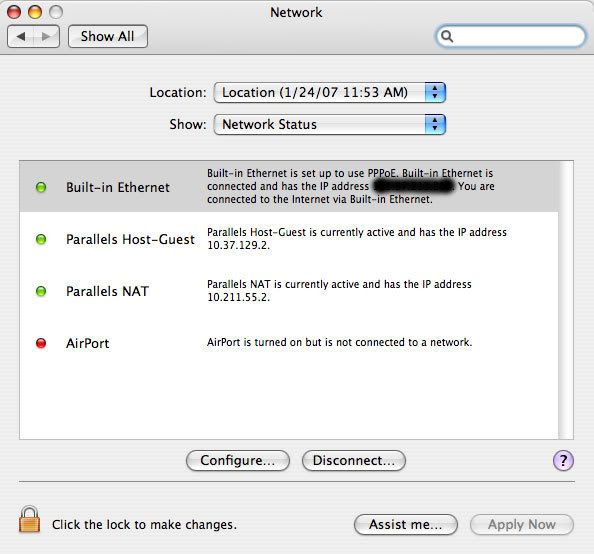
It can be argued that ordinary users need not know of such things. Seriously, not everyone may be inclined to tinker with their PC, but being it their device, having paid for thousands of dollars worth of money, wouldn't it be prudent to leave that option up to end users? The Mac for all its beauty and elegance and made for grandma to ease of use, doesn't dumb down the user--- it presents such network information in a clear way and if grandma doesn't want to look at it, that's great too (see
image to your left, pardon, I had to erase my ip address).
The dominance of Windows is undisputed. Corporations and governments around the world remain imprisoned by their reliance on Microsoft products. Where once the mantra was: picking IBM was a no brainer--- it has been usurped by Microsoft. Picking Microsoft for years as your vendor of choice was the no-brainer. No longer is that clear cut.
Times are changing. The move to 64-bit computing leaves a wide opening for people migrating to the new technology. Increased interoperability between documents through open standards like the open document format, is paving the way for Microsoft's dominance to be eroded. The ability to communicate with people on Windows machines--- via such mechanisms like Windows Share/
Samba or through
OpenAFS or through other groupware collaboration techniques are instrumental for new buyers to consider other platforms like Linux and
Apple. The increasing reliability of Internet-based applications like
Google Docs and Spreadsheets and groupware technologies and our increasing dependence on our online World is also adding to this shift.
It is fast becoming irrelevant to simply lock yourself on a single platform, unless you happen to have a specific demand for it.
Virtualization of the Windows operating system that is allowing Data Centers everywhere to virtualize windows servers, or for users of
VMware and
Parallels to run XP or Vista on their
Macintoshes is further proof that having a PC and being dependent on Windows is no long of paramount concern.
Parallels has a feature called
coherence that makes windows and windows applications, look like a native mac application:
What does this mean? Simply: Windows-only applications can run on either Linux or Macs via Virtualization!
The cost of acquiring a PC based Windows computer, and a Macintosh one is now on a 1:1 basis, given the value of both devices. It can also be argued that unless you are proficient enough, in spite of Linux distributions being free, the cost of installing and learning it and figuring things out as opposed to the ease and simplicity of the Mac, may also put Linux in a 1:1 condition with a Macintosh. On one hand, the daring PC user, seeking alternative options can simply download a LiveCD and be on Linux without so much as installing it or learning anything about Linux. And this is an important factor in increasing Linux Desktop share or making people aware of the greatness that is Linux.
Windows Vista faces tough opposition. Sleek, and modern, Vista may look to a lot of people. arguably, it is old news to people who are on Macs and quite recently: Linux. Linux you say? Aren't they the bunch who have such grotesque user interfaces?
Take a look at Sabayaon, which can run on a
LiveCD (torrent) with full 3D graphics turned on. That's right, Live-no-install-required-to-try-CD or
LiveDVD (torrent). The minimum specs:
- i686 Processor (starting from AMD K6 and Intel Pentium II)
- at least 256Mb of RAM (512 suggested)
- an OpenGL capable 3D graphics card (mostly NVIDIA, ATI, Intel, VIA)
- a DDC capable Monitor
Play the video to see what a
Sabayon Linux can do for your two year old, aging computer:
Arguably, Sabayon isn't a household name, when it comes to Linux distributions. The more familiar is
Ubuntu, which is "Linux for Human Beings". (torrents:
Ubuntu LiveCD,
LiveDVD). Take a look at this Ubuntu video:
Linux and the Mac share pedigree. Both have
Unix in their blood. command line based applications used for webservers or developing web applications are easily ported across each other, mostly from linux going to Mac. Many developers on Linux carry and use Macs to develop software on linux!
The added value of going Mac for most people is that it is more general purpose than linux. It isn't every day you code, or write on a word processor or spreadsheet. The life style applications that come freely with the Mac like iTunes, iPhoto, garageband and the ability to communicate with more devices (than in linux) such as digital cameras, scanners and printers make it the greater value choice as a desktop machine. For example,
Attorney Renee Mancino is a one woman legal office using her Mac.
More and more small businesses are leveraging Macs. The Mac has become the perfect symbiosis between working and playing.
The PC gaming genre is dominated by Windows PCs. DirectX based games make it so much harder for people to develop on other platforms like Macs or Linux where it doesn't exist, even when there are perfectly standards-based frameworks like OpenGL for developers to choose from. That too is changing.
If you're on Linux, and want to play games, chances are you've either tried three things: installed and run wine, which is an implementation of DirectX on Linux, played the many addicting native linux based games or paid transgaming to run games on Linux.
If you're on Apple,
Aspyr is a company that have ported popular games, including
The Sims 2 to the Mac.
Blizzard Entertainment--- makers of the Warcraft francise have always developed for the Mac and their
Warcraft III games, and World of Warcraft are native residents of
OS X.
Michael Dell has joined the swelling ranks of Linux Users. He is reportedly a user of Ubuntu and quite recently, his company has plans to begin shipping Linux PCs.
There are many who simply refuse to switch platforms because they're intimidated by it. What can we say to users like these? They've got to be encouraged to try either one out. Sometimes, it is also a case of having been living in the dark world of windows, they've lowered such expectations that they work for the computer. it is suppose to be the other way around.
If they've chosen Macs--- they're by far the easiest and best value for your buck.
Productivity tools like
QuickSilver and
Applescript and smart folders exist on the Mac. They make loading applications or finding data so easy--- just a few quick tap on the keyboard (the mouse is hardly needed in such operation) and your app or data (for example music or a photo) will be opened for you is a prime example of the computer working for you and not you having to mold your way of doing things to the limitation of the computer's operating system.
video from leo laporte's twit.tv network, "Macbreak: Quicksilver"
Summarize--- (click:
a Macbreak Podcast on Summarize) a fabulous tool that lets you summarize any text, pdf, document in minutes is especially useful in generating quick executive summaries for reports or you simply just want to get the gist of an article or web page's lengthy gibberish. (don't worry, i won't take it against you if you did that with this post).
Coming from a Windows world, arguably the cheapest way to find out what you're missing is to download and run a Linux LiveCD or LiveDVD. that's right:
run, not install. You don't have to install Linux to give it a go. Distributions like Sabayon or Ubuntu lets you experience whats it like without having to install it. the full 3D windowing experience is just a prime example. Each liveCd is normally outfitted with at least a browser and sometimes
OpenOffice--- hence you get to do your work.
Like people who switch from Windows to Macs, people who switch from Windows to Linux have expectations that things will remain the same. They bring their windows preconceptions to the table: like device drivers. As
Caitlyn Martin explains in
Performing Brain Survery on Yourself (a must read for every Windows to Linux Switcher) it isn't the same thing:
Linux isn’t Windows. There are no .dll or .inf files. Those are exclusively Microsoft concepts. Working with Linux (or FreeBSD or MacOS) is an exercise in dropping your ingrained Windows concepts and learning a different way of doing things. That’s precisely what Linus Torvalds meant by “performing brain surgery on yourself”, For some people that initial learning curve is just plain difficult. Nobody said this would be easy for everyone.
It's a whole different and exciting world!
The distributions that have built themselves on top of the Linux kernel are so many, so multifaceted that often you drown in too much choice and information. That characteristic makes it beautiful. The Beauty of Linux is that like the PC before it--- it lets users do what they want to their hardware. They can build a decent car or a supercar out of ordinary commodity items readily available from your friendly local computer shop. There are infinite possibilities in a do-it-yourself environment such as linux. It brings to software, the open-unshackled-form -vendors' mantra that the PC was built on. So much so that you can even build yourself a supercomputer in your garage using Linux. Linux is simply power personified.
The Mac on one hand is the quickest, easiest, way of getting any job done. The easy networking capabilities of the Mac and
Xgrid allow Mac users the easiest way to build a compute cluster. From
science computing innovation, to
cost efficient dicom archiving and viewing, to
million dollar presentations, to writing
mac based applications to web-based applications, or simply emailing grandma and maybe write that report due on monday together with that
keynote you need to finish. It is the perfect device that bridges work and play, makes you look good and it
leverages the Power that comes with its Unix pedigree and gives it some finesse.
A lot of people leave windows behind because of the sheer trouble of Bots, trojans, viruses. They won't leave their Windows boxes for these reasons: 1) a specific work application is needed; 2) they believe there is no equivalent mac or linux app that lets them work along side their windows-carrying buddies; 3) they want to play games and linux or the mac don't/wont support what they want; 4) cost; 5) the Mac or Linux look "too high tech", and are frightened by it. We've successfully answered each of those reasons.
Beyond the philosophical arguments of remaining a Windows user, the cost-performance benefit to users to switch is beyond reproach. Still: from across the Americas, to the land down under, from
Munich, to Asia, to the heart of
Red China, from the
Top 500 supercomputers in the world, to
financial centers, from ordinary folk, to borrow
Mr. Linderman's words: "
we have our roles to play in the events to come".Be part of the Revolution! Arm yourselves with Macintoshes! If you choose, liberate your PCs with Ubuntu! Unshackle them with the Power of Sabayon! The Revolution is taking the world by storm. Will you help bring an End to the Dark Age of Computing? it's time to save the world from the constraints Windows has imposed upon Users. Will you
enlist with us?
specific links/resources, if you're in the Philippines:
1.
philmug - for all your mac-related questions
2.
plug - philippine linux users' group
3.
longbeard for all your Mac or PC gear needs.
4.
bayanihan linux - if you're feeling nationalistic, it's a linux distribution.
some additional reading/links:
1.
forums like cnet.
2.
linuxtorrents - all distros
3.
50x15 initiative
 MinWin - Microsoft internal only project. I like the asci windows flag. MinWin is shown here running via MS Virtual PC.


 Posts
Posts


